
It takes a masterful playwright and confident direction to turn a dark tale about the abuse of power into a funny and entertaining romp. The new production of The Hothouse at Trafalgar Transformed only just stops short of dunking Pinter’s piece into custard and pie. The result is uncomfortably chilling, twisted and a joy to watch.
[](http://img.svbtle.com/8wi7z4d7uy7vcw.jpg)
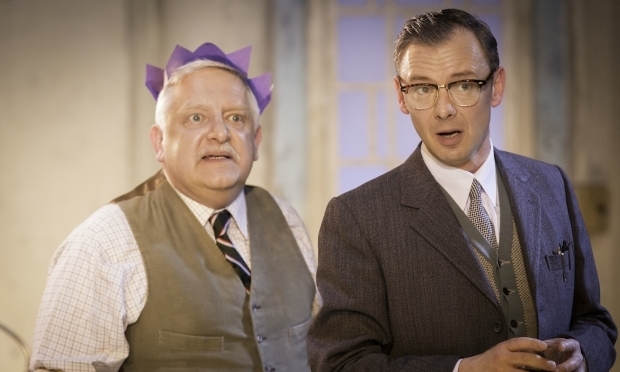
>John Simm (Gibbs) & Simon Russell Beale (Roote) © Johan Persson
As with his Macbeth earlier this year, director Jamie Lloyd skilfully manoeuvres the production with a stylistically consistent hand. Instead of spit, gore and blood, this time around the direction heightens Pinter’s virtuous language and absurd monologues into darkly comedic spheres, and a supreme cast helps the production on this tricky balance act.
Simon Russell Beale plays the leader of a sanatorium that claims to heal people of aberrant behaviour, but it’s the institution itself that has caught the incurable disease of arbitrary misuse of power. His ex-colonel Roote is at once incensed and slightly flummoxed by the events taking place on an unfortunate Christmas Day. One patient is dead and one patient has given birth – it’s all rather embarrassing for the state institution, the precise purpose of which we never find out about. A very physical performance from Beale, but huffing and puffing the way he does one wonders how Roote got into power in the first place. Much like most of today’s long-reigning despots one assumes that too much power will let you lose contact with reality a bit.
After being directed by Josie Rourke in Dürrenmatt’s The Physicists last year, John Heffernan returns to a similar kind of mad house where people are being mysteriously murdered and tortured. This time he is brilliant as the mischievous underling Lush, although at times Heffernan might be enjoying himself a tad too much on stage. Who can hold it against him? The interplay between the characters is impeccably smooth and full of energy, never failing to sustain the intricate banter created by the playwright.
John Simm is flawless as bureaucratic Gibbs who tries to climb the rank ladder and cleverly hides his monstrous motivations behind ministry procedures and report chains. The men’s power appears to be practically pheromonic to Indira Varma’s Mrs Cutts.
Soutra Gilmour’s design brings a bare, clinical creepiness onto the stage. Roote’s office and the examination room with its menacingly dangling wires are somewhat reminiscent of every soul-sucking office building in existence.
As elusive as the some parts of the play may seem when perceived through the walls of Pinter’s linguistic trickery, there is a clear political undercurrent dealing with the social responsibility of those in power. Although the characters are never cyphers it is surprising, especially for a piece that’s so bizarre in its tone, how all of these character and behavioural traits can be found in everyday political power structures. Lloyd takes to Pinter’s advice that in political theatre condescending “sermonising has to be avoided at all cost” and avoids spoon-feeding the moral of the piece. Instead, the marriage of a sublime, unsettling visual style with Pinter’s wit, full of alliterations, serpentine off-set rhythms and melodious, nuanced repetitions creates a texture that’s not entirely whimsical, but not square in your face either.
The absurdly comedic surface is constantly broken by echoing sounds of distant screams from never shown inmates being subjected to dubious treatments. All actual depictions of torture are comical to a disturbing degree and Harry Melling as the aptly named Lamb gets to suffer the full extent of other people’s ambition and commitment to tyrannical legacies.
What we get with The Hothouse is not a moralising tale about abuse of power, but an examination of characters who have been in power for too long, or those who aspire to power. When Hannah Arendt observed the banality of evil in state-sanctioned mass murderer Eichmann, the shock was to find it didn’t need a psychopath to commit atrocious crimes. All it takes is ordinary people and the right circumstances. That Jamie Lloyd turns this theme into a belly-shakingly funny romp makes it even more chilling.