The World Mouse Plague

An old lady is about to be evicted from her home because an artist is doing an important site-specific response piece in the building. “Social cleansing under the cover of art”, she calls it and then a guy in a cat costume walks on and snarls at the audience. To call Ridiculusmus’ show The World Mouse Plague eccentric would be putting it mildly.

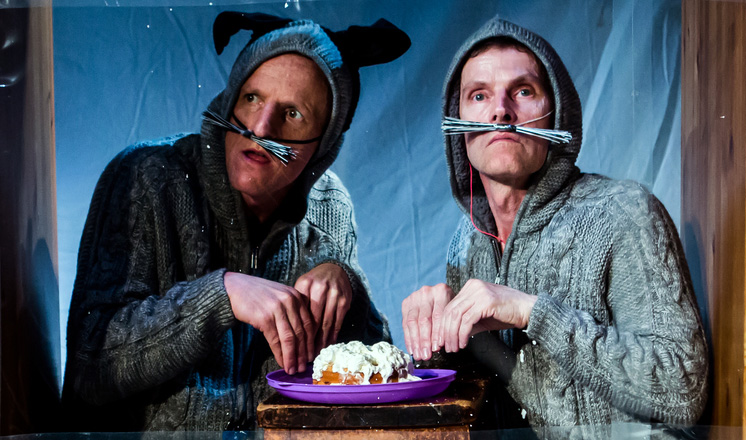
Despite an ominous warning in the blurb I didn’t actually have to wear a mouse costume which was both disappointing and, given the recent track record of gimmicky immersiveness in theatre land, a great relief. In a string of start-stop, narrative dimension shifts scenes that would have made Baudrillard proud the creators Jon Haynes and David Woods mix acute self-reflexive commentary with a seemingly whimsical performance style. The play is decidedly not above wordplay and silly Tom & Jerry slapstick chases around the auditorium. The two performers scurry around the stage in crappy whiskers and impressive fur tails to give Arts Council Funding tick box theatre projects an elaborate meta-kicking. They’re shit, they say, well, mouse droppings, anyway.

It’s ceaseless. “Are you with Punchdrunk?”, the performer teases someone in the front row after accusing them of sabotaging the show by deleting material from their show, an immersive durational headphone verbatim allegory of stage four genocide. If you’re not in on the joke it’s just one long bizarre sequence of two guys dressed as mice talking about infestations and Holocaust novels.

Although surprisingly firm in its moral stance on role of the artist in the gentrification process these themes are tangential and only tucked into folds of a metatheatre piece which demands the audience to be on the ball. For it to work it needs the audience to care about conventions of established and emerging theatrical formats. Only then it manages to infuse criticism from within a performance context itself.

Electra

She can no longer stomach the size of her sorrow, Electra says, but neither can the others at Aegisthus’ court. Her mother, her sister and the chorus, all want her to stop lamenting Agamemnon’s death. Her father, killed years ago by her mother Clytemnestra and step father Aegisthus, hovers over Electra as a soul-sucking memory leaving her gaunt and hollow and incapable of pursuing anything else in life. She cries out to the gods about the unjust punishment she is receiving and she wishes for nothing more to revenge her father.
 
There is no hope for any life and redemption to return to the cursed house of Agamemnon. A massive dead tree on the Old Vic’s in-the-round stage, designed by Mark Thompson, and Kristin Scott Thomas, swapping her upper class coolness for mental instability, circles it, throws herself in its shadow and generally strikes a miserable figure in her pauper’s gown.
 
Scott Thomas was very eager for a role in which she could use her face for more than calculated composure, and here she really goes for it. Disheveled, she thrashes around on the sandy floor while waiting for her brother Orestes to return and avenge the father. In the first half of the play we find Electra a wailing mess, like a less cunning Hamlet moaning about and accusing the matricidal mother to anyone who will listen.
 
When you join a character in the middle of a sustained nervous breakdown there’s usually little way left to follow them down the psychological rabbit hole. So what we witness here is a woman who, after mourning for years, slowly begins to gain her wits again, finding resolve and coming apart again. It’s in this bipolar realm of emotions that Kristin Scott Thomas can show off her range and as everyone tries to reason with her she loosens up a bit, charging between spite, incredulity and more woe.
 
There’s a palpable barrier between Electra and the people with whom she is forced to interact. Liz White’s Chrysothemis can’t get through to her grieving sister and it shows plainest in their physical interactions. Even when they are on the same page when it comes to questions of honour or revenge their touches and embraces are brief and indecisive. When her saviour, younger brother Orestes, finally shows up their connection feels vague and insincere. They clutch each other awkwardly, the kisses are cold and vague and are fuelled by the fact that Jack Lowden constantly tries to shake the madwoman off him so the revenge plot doesn’t get spoiled.
 
Maybe some of this stems from the feeling that Thomas is in a different play to the rest of the cast. With her almost modern conversational and spluttering speech and her far from majestic gesticulations, she’s royalty fallen from grace, an outcast of the court because of her erratic behaviour. Diana Quick’s Clytemnestra sobs dry tears, retching emotionally but always aiming to keep up the regal façade, and when Thomas verbally spars with her there is an unavoidable jarring between these two styles of performance; it feels as if something about this potent mother-daughter conflict has fallen through the cracks.
 
All the while Liz White’s composure in the face of all the wretchedness her sister goes through is wavering. She is not necessarily as detached from her sister’s sorrow as other Chrysothemis that have come before her. However, her compassion makes any accusation of complicity Electra hurls her way somewhat superfluous. This Chrysothemis is not complicit, she’s a gormless pawn and White’s response to the matter is the ever-creasing brow of being conflicted.
 
PJ Harvey’s non-diegetic music while ominous is used merely as decoration and adds no further layer to the inevitability of the tragedy. Of course, there are some issues with Sophocles’ text itself. Aegisthus (Tyrone Huggins) only shows up in the last few minutes but he has the most important line in the whole play. Will we keep on murdering? Is there no way to stop the spiral of violence? “Is this house forever cursed?” Look at Electra’s hollow eyes and the dead tree that’s reflected in them and you know the answer. This woman has suffered too much to let it go. This inability to let go of resentment is at the core of a lot of human conflict. The text naturally lends itself to an exploration of this theme and it’s somewhat surprising that Ian Rickson’s version balks at pursuing this aspect in more depth.
 
Crucially, Sophocles’ play does not allow for female self-empowerment however twisted and misguided it might turn out to be. Electra suffers but she stays pure in her actions and bids others to her work for her. How different to Euripides’ Medea, this year’s other Greek tragedy featuring a female big name star. Helen McCrory’s tragic heroine could be seen digging much deeper into the pain of being abandoned and outcast than Thomas does in this unembellished production.

Shoot, I Didn’t Mean That / The Last Days of Mankind

Karl Kraus was one of the most acutely-observing writers in the German language and Time Zone Theatre now presents the epilogue of Kraus’ epic piece The Last Days of Mankind: The Last Night in a new translation by Edward Timms and Fred Bridgham.

Together with Shoot, I Didn’t Mean That, a piece of new writing by Catriona Kerridge, this double bill creates a worrying lesson on humanity’s inability to learn from past mistakes. Other mechanisms and gestures around the event of war are pulled into focus and their macabre absurdity is revealed.

Not the pathos around male sacrifice but the stories of four women are at the centre of the Kerridge’s play which forms the first part of the evening. The story cuts between a British traveler, an interpreter and two school girls all of which are confronted with circumstances that force them to reflect and act on war itself, and on what the symbols around it mean in modern life.

Alexine Lafaber plays a tourist in Vienna who does the Nazi salute in front of a Jewish shop keeper and is subsequently put into jail. With her physicality becoming some sort of a hyperbolic manifestation of all the radicalised and mismatched comprehension of historic events, Lafaber delivers a surprisingly personal comedic performance.

Emily Bairstow’s boldness in her role as an interpreter at an international human rights court reminds at times of a young Julianne Moore. Here the traduttore-traditore is done with betraying her own beliefs and refuses to be the voice of further apologetic paralysis. Although confined to a tiny glass cubicle Bairstow dances with tango with Catriona Kerridge’s clever text which is enriched with pop culture one-liners and lots of laughs. Every insincere apology she’s forced to translate charges her up and has her almost bouncing against the walls.

Remembrance rituals and formal education around the two big wars often provide a lot of context and historical facts. It is astonishing, however, how often they seem to fail to equip young people with the necessary tools to make sense of the recent influx of violent news images of kidnappings, killings and refugee life which are broadcast from conflict areas in the middle east. Although this strand of the narrative might jar tonally with the more comedic rest of the piece, the story of the two school girls (played Jocasta King and Alexa Hartley) grounds the piece in a worrying reality where radicalisation can happen to anyone.

In Shoot Director Pamela Schermann goes for a no-nonsense straightforward style allowing the actors to breathe around the serious moments without ever imposing on the witty script. The second half finds the jolly tango turned into a sinister Totentanz. Schermann pulls off visually enthralling collage of Kraus’ epic The Last Days of Mankind which was written as a response to the outbreak of the First World War.

The stage, given an apocalyptic stony cliff-like look by designer Mike Lees, is no longer broken up into three segments but is entirely filled with the mayhem of fight and death. The same four female performers, now equipped with gas masks, become soldiers, hyenas and ruthless war correspondents. Highlighting humanity’s inability to learn from past mistakes the director blends references to wars from different centuries into the picture. Kraus’ measured language is mixed and jumbled by rumbling lighting and flashing sounds – it’s effective and engulfing. Moralising was far from the creator’s minds; these pieces are dark satires – and don’t you ever forget it.


Karl Kraus Poem in “Die Fackel” 1933/Translation
>A response to The Last Days of Mankind: The Last Night

Man frage nicht, was all die Zeit ich machte/Don’t ask what all this time I did
>I laugh about the woman doing the Nazi salute.

Ich bleibe stumm/I remain speechless
> Mortified by the sound of my own laugh.

und sage nicht, warum./and don’t say why.
> I’m German.

Und Stille gibt es, da die Erde krachte./And silence where the earth shattered.
> When the final bomb hits I applaud.

Kein Wort, das traf;/No words to find;
>”Sorry seems to be the hardest word”, she sings. Apologies are useless when you don’t learn.

man spricht nur aus dem Schlaf./only talk in sleep.
> My generation washes (and washes and washes) its hands of the atrocities

Und träumt von einer Sonne, welche lachte./And dream of a sun that once shone.
> by remembering.

Es geht vorbei;/It passes;
> The shot the girls fire is final. The bullet irrevocable.

nachher war’s einerlei./in the end it never mattered.
> Somewhere they still shoot. Always will.

Das Wort entschlief, als jene Welt erwachte./The word passed away when that world woke.
> Noone learns. A monstrous laugh.
The Wall at the Old Red Lion

There’s that one summer where hopscotch gets left behind, the football gathers dust in the corner and when exploring sexuality or alcohol become way more important than school exams. In Mayford Road’s production of D C Jackson’splay The Wall acrobatic verbal dissent between four teenagers breaks up the syrup of summer holiday boredom, and a wall, somewhere in a small Scottish town, becomes the scene for a tender look at adolescent turmoil.

A group of loquacious teenagers wittily discussing their crushes and their view on the world could easily turn into a tedium extraordinaire were it not for something more substantial hiding between the lines. Assumptions and secrets are the foundation of the union between 15-year old Michelle and 17-year old Barry. Ben Lambert turns Barry into a lanky and thoughtful guy, who is just that little bit too serious. Isla Coulter’s demanding but equally awkward Michelle has decided that he’s perfect for that bit of summer loving she’s looking for. Then, there is Barry’s younger sister Norma who works herself into a frenzy over a bit of hash she has nicked from their father. Roslyn Paterson laces a droll innocence into the immediacy of teenage angst; her wry and literal interplay with big mouth Rab (Corran Royle) is a joy to watch. He is the bam philosopher who has an opinion on everything but is himself too shy to act on his infatuation with another neighbour’s girl.

As if that weren’t enough, all of them have to face the fact that they are slightly screwed up by their parents’ neuroses. They inadvertently carry around with them the older generation’s baggage which is full of the same anxieties and padded with personal and political disillusionment. The undergrowth of parental failures is breaking up the conservative lid that was put on in the 80s and is now showing in the confusion of the children. When the story turns a familiar shade and exposes a big hidden secret, it does so without patronising the audience. They can keep up; D C Jackson knows. The plot unfolds in a traditional manner but we’re not here for that. We’re here for the microwave of adolescent emotions completely untainted by adult commentary or judgement.

It’s like a flip side to April de Angelis’ Jumpy, which deals with the fallout of a teenage pregnancy. Here the focus is entirely on the disillusioned parent, who judges the aberrant child and inflates both their failures as some kind of tragic-comic, inevitable tragedy of modern urban life. When drugs, alcohol, and sex are in the same context as children, it’s common to move into bleak social criticism that punishes the loss of morals with criminalisation or at least damnation of the involved parties. The Wall creates a world in which children testing the waters of who they are, allows them to remain innocent. Under David Ricardo-Pearce’s direction, not the threat of ASBOs but wafts of Regina Spektor and precocious self-awareness carry this refreshing twist on social commentary through to the end.