Featured

Featured: Visual Monsterisation Strategies

Monsters thrive in the messy swamps of pop culture. They live in the fertile space where classic literary narratives and traditional aesthetic norms are blown apart by visual strategies. They are born at the crossroads between political turmoil and contemporary taste. The particularly adversarial climate of the current American Presidential election campaign proves that monsters are nourished by culture’s incessant need for new imagery.

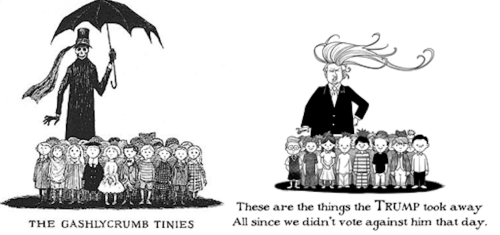
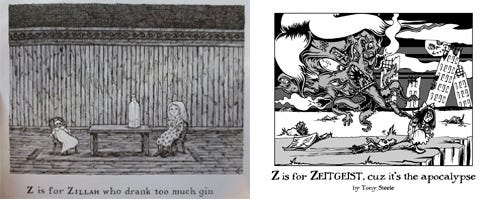
In an example from a couple of weeks ago, game designer Mike Selinker worked with several illustrators to produce an adaptation of the well known ABC book The Gashlycrumb Tinies by Edward Gorey. The original 1963 illustrated book is an assembly of macabre pictures about children meeting their unfortunate ends through such creative mishaps as being “sucked dry by a leech” or being “devoured by mice”.
Gorey Trump

In 26 different images, the 2016 persiflage transposes the visual language of the original source directly onto a set of new images. While most of the illustrations in the amusing A-Z feature distorted drawings of Trump, it is the last picture that eventually sees him morph into a tentacled, bog-eyed and bewigged creature, wafting over a dystopian landscape and ushering the little girl Zeitgeist over a cliff. The Trump ABC is a reinterpretation directly addressing a range of policy issues that the illustrators see as marking out the Conservative candidate as unsuitable for the office of Commander in Chief. In doing so, it relies heavily on the retention of the original alphabet structure and uses textual elements to deliver its criticism.
Gashlycrumb

This first example shows the ways in which satire allow us to make sense of current issues through already familiar visual contexts. While stealing from or ‘being inspired’ by other art work is one of the most common ways for artists to find authentic expression for their own ideas, most monsterisation processes are a lot more complex than this. Often when a new monster is born, it dodges attempts to be assigned a conclusive meaning. This is not only because it draws its fangs and slimy limbs from a variety of visual sources, it also relies on the violent deformation of forms and contexts. Monsters leech off images that are freely circulating in popular culture. In their bellies they churn around these ideas and regurgitate them into new, puzzling and scary shapes.

When monsters fuse the remnants of several texts and images onto their bodies, it is not only incredibly difficult to make out the exact sources that have served as inspiration; exactly what they are saying, alluding to and achieving also becomes much more ambiguous.

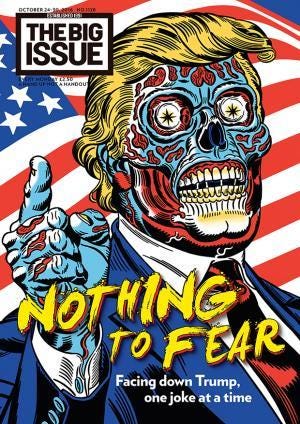
In October, a Big Issue magazine featured a cover illustration of Donald Trump in jarring colours reminiscent of the iconic ‘Uncle Sam’ image in which a man points at the onlooker. Big Issue, for those not familiar with the British publishing landscape, is a magazine set up as a social enterprise and which has been around since 1991. It prides itself on producing high-quality journalism and is published on behalf of homeless and vulnerably housed people who are able to support themselves through working as street vendors. The magazine covers are usually laid out in striking colours, sometimes featuring celebrities or allusions to current affairs. The picture on that particular issue is special because it is not merely an amusing picture of a person of current interest, but because Trump has been turned into a zombie-like creature. The aesthetics of the figure are directly informed by the John Carpenter alien invasion B-Movie They Live which was made in response to Reaganomics. In the film, a special pair of sunglasses allows the wearer to detect the weaknesses of the American democratic system as personified in fleshless aliens. Below I hint at the various visual and pop culture influences that have come together in this figure.
Donald Fear

The origin of Uncle Sam as the personification for the United States is apocryphal but likely dates back to at least 1812 when America was still, or yet again, at war with Britain. It took about a hundred years, until 1916, for the image we know now to solidify into its iconic state. The illustration by artist James Montgomery Flagg appeared first in the magazine Leslie’s Weekly under the title “What Are You Doing for Preparedness?” and later, in the Second World War, served as a military enrolment poster. The creature with its exposed jaw and teeth also has distinctly zombie-like features. The idea of Uncle Sam as a zombie is not new: in 1996 — a time in which the States were involved in numerous military operations all over the globe — a horror military comedy lured punters into the cinema with the catchy tagline “Uncle Sam wants you… dead!” Now, this unspecific personification of America’s national pride has been swapped for an actual politician.

This Trump Monster both invokes the uncertainty about America’s future and plays to the popular conceit of a dystopian apocalypse. The flesh is taken off its face, revealing the sinews underneath which are made up of the colours of the American flag. The ‘rotten core’ forms a visual antithesis to Obama’s iconic 2008 election poster in which the colours of the flag are unambiguous and blocky, an image surface on which ‘Hope’ is quite literally projected. In contrast, the projection of fear reflects back at us a jarring zombie-esque face, and instead of “Hope” an ironic “Nothing to fear” in a B-Movie alien flick font is splattered across as an ominous warning. The Trump alien erupts from the complex paradoxes that underlie American history exactly in that moment when the patriotic idea at the core of Uncle Sam is twisted into senseless oblivion by a demagogue.

Wants You

Another example draws heavily from European cultural history. Greek mythology, with its unreasonable deities and suffering demi-gods, has been a rich source for artist reworkings throughout the millennia. Cursed by the goddess Athena for ‘laying with’ Poseidon in a sacred temple, the snake-headed female Medusa has become a popular choice especially when attacking women in power.
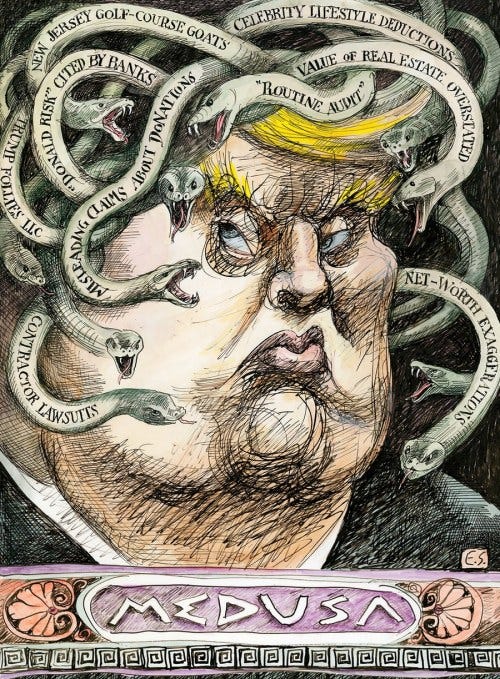
Donald Medusa

Vanity Fair’s illustration by Edward Sorel which depicts Trump as the ancient Gorgon beast appears a strange choice for a refiguration of Trump as monstrous. According to some interpretations of Ovid’s take on the story, Medusa was cursed by Athena after being raped by Poseidon. It introduces a strange irony into the picture to cast a man accused of, and bragging about, sexual assault in the role of a vilified woman. There is, after all, a history of female artists of reclaiming monstrous females, such as Medusa, to probe female relationships (Sylvia Plath, for example, wrote a poem about her mother which alludes to the myth).

The article accompanying the picture discusses the convoluted tax issues around Trump’s business empire. Therefore, the central themes of the underlying myth have been completely emptied out and have little bearing on this new monster. Instead, an amusing jibe about Trump’s unruly hair is fused with the symbolic character of the serpent standing in for regeneration. This aspect is perhaps more prominent in the myth of the many-headed snake creature Hydra which regrows a new snake head when one has been hacked off.

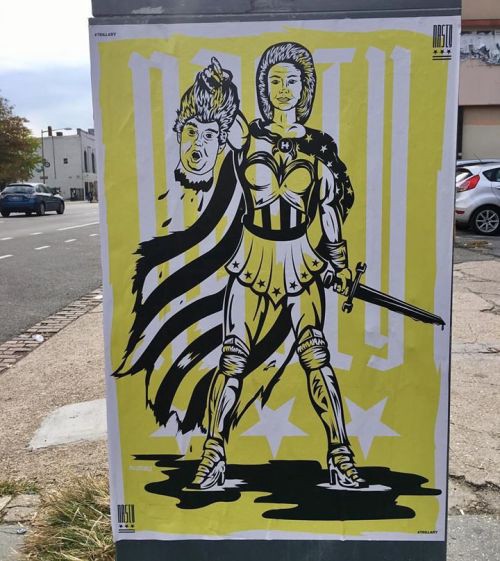
More intriguing in context with the same mythical background is this street poster which depicts Democratic nominee Clinton as a female Perseus slaying the Medusa. While the askew Medusa/Trump parallel is still present, the focus of the image is on Clinton dressed as the American comic book super hero Wonder Woman.
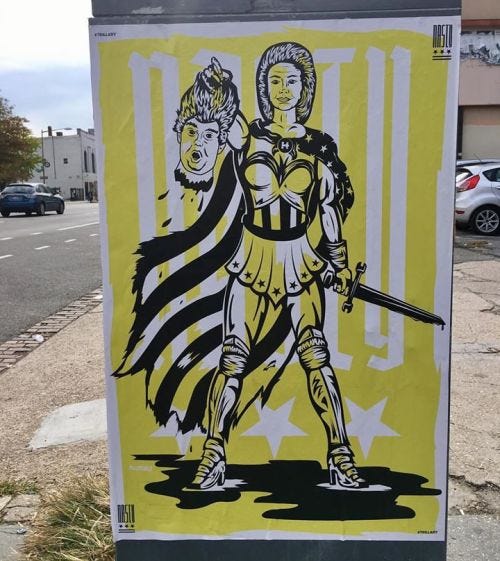
perseus

In the original myth, the alliance between the cursing goddess Athena and the conquering hero Perseus stands opposite the ‘perpetrator’ Medusa. The two women, according to art historian Marina Warner, act out the conflict between a woman being able to demonstrate masculine strength and her role as a fertile woman and victim (in her moment of death Medusa gives birth to the fantastic beast Chrysaor and the winged horse Pegasus). In the act of violence committed by the new Clinton-Perseus lingers the rejection of traditional binary gender circumscriptions that govern how are females in power are supposed to act.

feminist

The picture also alludes to the misogynistic attack that Trump has repeatedly launched at Clinton. On top of the figure the word ‘nasty’ is printed in a celebratory gesture of reclaiming a word that was meant as an insult. The way that figure and font are positioned in relation to one another echoes pop artist Beyoncé’s reclaiming of the word ‘feminist’ in one of her performances. Only in taking on the role as the Medusa slayer and exerting violence, the proto-masculine hero turns into an empowered female. For those who want to know more about the Medusa, Elizabeth Johnston has written a great article for The Atlantic examining how, throughout history, powerful women have been vilified through portraying them as the gorgon.

To finish off this menagerie of political monsters, I would like to share one of my favourite Trump monsterisations. It comes from a blog on tumblr that regularly posts stomach-churning photo manipulations using a different, uglifying strategy.

donald trumo

Instead of overlaying countless intertextual references, the artist reduces the facial features of Trump to only a few aspects (hair, chin, mouth) and distorts any human familiarity. It’s a literal defacement of the politician the artist would like to get rid of. This deformation transfixes the perceived human failure of the candidate on moral, ethical and behavioural levels onto the visual body of the new monster.

When new creatures come to life, an awareness for the visual strategies involved in their generation is vital in order to pin down the heavily politicised ideologies behind them. The kinds of monsters we encounter in popular culture are part of the currency of creatively facing contemporary challenges.

Sources:

The Ghastlycrumb Tinies: https://www.brainpickings.org/2011/01/19/edward-gorey-the-gashlycrumb-tinies/

The Ghastlytrump Tinies: http://ghastlytrump.com/

Big Issuehttp://www.bigissue.com/the-mix/latest-issue/7059/issue-1228

Vanity Fair article: http://www.vanityfair.com/news/2016/06/the-great-trump-tax-mysteries

Vogue endorsement: http://www.vogue.com/13492873/hillary-clinton-endorsement-president-united-states-democrat/

Medusa and women in power: http://www.theatlantic.com/entertainment/archive/2016/11/the-original-nasty-woman-of-classical-myth/506591/

Marina Warner, Monuments & Maidens, (London: Vintage 1996), pp. 113–114.

On Defacement: http://nagualli.blogspot.de/2013/03/michael-taussig-from-defacement-public.html

Dinild Trimp http://dinild.tumblr.com/


Originally published on icollectmonsters.tumblr.com

Republished on the Monster Network.
Dialogues

All the dialogues and critical discussions on Exeunt and other sites that I’ve contributed to.

January 2019: The Exeunt staff discusses its favourite 2018 shows.

September 2018: A dialogue review with Dr Emilie Oléron Evans about The Lesson at the Hope Theatre.

November 2017: A discussion with Leila Essa and Doriane Zerka about the European theatre festival Voila.

May 2017: Long Theatertreffen Dialogue with Lee Anderson in which we talk about 89/90, Three Easy Pieces und Die Borderline Prozession

January 2016: New Mourning
Exeunt contributors think about how the internet has changed our experience of collective, and individual, mourning.

December 2015: The Top 10 of 2015

July 2015: The Invisible by Rebecca Lenkiewicz
A Dialogue review with Legal Aid lawyer Jeinsen Lam

June 2015: #completeworks
Live-written responses to Forced Entertainment’s Table Top Shakespeare.

May 2015: The State by Alexander Manuiloff
A Dialogue review with Rebecca Jacobson for Theatertreffen Blog/ExBerliner

April 2015: Kaleider’s The Money
A Dialogue review with Catherine Love.

February 2015: Keep on Burning
In 2013 the Lyric Hammersmith created The Secret Theatre Company. This weekend marks its Grand Finale. To mark the occasion Exeunt’s writers look back at the shows, the critical reception to them, the highs, the lows and the legacy.

January 2015: Buried Treasures
Exeunt’s writers dig deep into Islands, Caroline Horton’s new – and divisive – show at the Bush Theatre.

December 2014: Exeunt’s Highlights of 2014
Exeunt writers pick their personal high-points of the past theatre year.

December 2014: Oh, Pomona!
Exeunt writers attempt to unpick why it is that the Orange Tree’s production of Alistair McDowall’s Pomona has got under everyone’s skin.

November 2014: Sense of An Ending
Closing moments and after-shocks: Exeunt’s writers discuss theatre’s most powerful and affecting final scenes.

October 2014: The World Mouse Plague Dialogue with Tim Bano

Frankenstein at Battersea Arts Centre

I press the inside of my palm onto my throat, thumb resting on my jaw bone. The tongue in my mouth, sticky and heavy, presses against my front teeth. A heartbeat against the heel of my hand. I begin to hum. These vibrations. This is my voice. I rip it out. As I dig my fingernails deep into the flesh, the skin splices open delicately. I need to tighten my grip and use some considerable force to pull. These vocal cords are sturdier than I thought. They stretch and stretch and when they finally tear, I lower my hand to the notebook on the table in front of me. I look down and see the purple lumps amid the reddish gristle. It’s beautiful and still hums. I spread my voice all over the page.

In 1818, a young woman found her then shocking literary voice and transformed an outrageous idea into reality: a genius scientist gives life to a new monstrous human, only to abandon it, be haunted by it and have all his loved ones killed. Two hundred years later, Mary Shelley’s characters and story have become so iconic that they’ve come to signify anything from complexity of climate change to the latest questionable neoliberal financial scheme.

Yet, it is not really the range of meanings that Frankenstein’s creature can take on that seems to have inspired the hugely successful beatbox show Frankenstein: How To Make A Monster, which has now returned to the BAC as part the of the Homegrown Festival: Occupy. Rather, it is Shelley’s own radical act of finding a voice as a young 18-year old writer that seems to drive the creative spirit of the show. And that is because beatboxing – the craft of weaving soundscapes during a live performance solely with the amplified human voice – is not at all unlike writing: a startlingly creative act that requires quick wit and talent and which can have a powerful impact on an audience.

There are two halves to the evening. Staged in BAC’s gorgeously rebuilt Grand Hall, the first hour is the ‘main show’ and we meet the five beat box performers each with their own character and vocal traits. Aminita’s singing voice for example will make your tummy lurch in that Whitney Houston-sort-of-way, or there are Glitch’s dizzyingly fast and dirty rhymes. Rather than a retelling of the source material, the show is an ongoing citation process that very loosely splices the overall story arc of the haunted scientist with very normal school-age worries such as bullying and smartphone addiction. These topics are never presented in a didactic fashion, however. Instead they are clothed in rhythmically and lyrically extremely sophisticated compositions that quote extensively from the popular and classical canon. Although I personally didn’t catch the Bach that some other reviewers spotted in the pleasing mêlée of references, I did get some others. It all sort of pleasantly vibes with richness of Hamilton or Sondheim.

Gig-theatre can at times feel theatrically lacking, as it sometimes awkwardly tries to transition from its spoken sections into its musical parts. There is none of that here. Developed over two year in the BAC’s Scratch programme and under Conrad Murray and David Cumming’s direction, the staging, lit atmospherically by Sherry Coenen, is confident, exuberant and witty. The second part of the evening is set apart quite deliberately and consists of a few sets of rap battles and improvisations in which the whole audience is entirely swept up. The mood in the room is certainly aided by BAC’s recent decision to introduce more relaxed performances into their programming – audiences are free to get up and join in and record their favourite sections of the battles on their mobile phones.

There was a moment during one of the battles in which an 8-year-old performer called Seth responds to his challenger by languidly repeating a few bars from the previous set. He stops and mockingly shouts: “This is not my style!” He lifts the mic to his mouth and within seconds the floor and walls of the Great Hall vibrate with an impossible mechanic rattle. A few gasps and then the crowd goes absolutely wild for the inhuman sound coming out of this young person’s mouth.

Youth engagement and participation projects in theatre are often thought of in terms of ‘giving voice’: to those underrepresented or disenfranchised. The BAC’s Beatbox Academy programme has been around for twenty years and it seems that this youth project does not understand voice as something that can be easily given. This show instead joyfully, confidently and – perhaps surprisingly – slickly stages how five young performers find and literally amplify their own voices.

When Viktor Frankenstein in Shelley’s novel meets his creature for the first time, he is so shaken by the encounter he claims the following: “He might have spoken, but I did not hear…”. Well, this Frankenstein is a real celebration of young makers being heard by an enthusiastic audience. Luckily, we seem to see this happen more and more outside of the theatre also. From the Nobel Peace Prize-recognised climate change activists Greta Thunberg and girls’ education activists Malala Yousafzai to young anti-gun high school protesters in the US, young people no longer wait to be given a voice. They take it and sometimes it’s messy and difficult and controversial. And, in the case of BAC’s Frankenstein, it’s also incredibly joyful.

The Lesson at The Hope Theatre

A new academic year is upon us and across the country swathes of new university students are settling into halls and grappling with their long reading lists. As freshers flu makes the round these first weeks, the Hope Theatre in London presents Eugene Ionesco’s théâtre de l’absurde piece The Lesson and offers a chilling take on that often most fraught relationship of all between teacher and student. Annegret Märten and bona fide university lecturer Emilie Oléron Evans discuss Matthew Parker’s new production.

Annegret: The story is of an eminent teacher and at first willingly-submissive pupil who turns to the professor so she can prepare for her further education. Ignoring the warnings of his concerned maid, the professor tests his student on arithmetic and philology. From here it gets absurd quite quickly and very violent towards the end. I expect the situation in the show doesn’t ring too true to what you’re experiencing in the classroom every week.

Emilie: You are trying to set me up and make me say ‘…You’d be surprised!’, but I will not fall into the trap. Just like Ionesco doesn’t fall into easy symbolism and sensationalism when presenting the fact that the world is actually absurd in the extreme. We as spectators then need to dissociate ourselves from that, but I can’t really brush off a play like La Leçon after leaving the theatre. It starts out as a subversive, entertaining farce and descends into complete madness. And there is definitely a lingering sense of unease because you cannot actually tell where that tipping point lies precisely.

Annegret: Matthew Parker’s production walks that line really well. The two performers between which the central conflict plays out achieve the striking feat of hitting broad comedy notes while continually building up to a chilling thriller climax. Roger Alborough as the professor moves from adorable irritability to physical agitation, while joyfully chewing through the author’s nonsensical word plays as if they were the most logical arguments. Sheetal Kapoor as the uber-eager student seems to be full of exaggerated tension in the beginning. Then, as the academic disagreements between the two pile up, she shockingly disintegrates in front of our eyes. This is foreshadowed early on in the play – and this line is delivered with glee, almost – when the pupil is scolded by the professor for knowing how to add but not how to subtract: ‘Integration is not enough. Disintegration is essential too.’

Emilie: Ah, you see, we should have known all along what Banksy was going to do, really. The line you mention is an illustration of my favourite thing about the play, and more generally about Ionesco’s théâtre de l’absurde: the deliberate confusion between literal and figurative meaning, which here invites us to reflect on the nature of mathematics themselves. That’s not bad for an evening above an Islington pub! This is enhanced by Ionesco’s stage directions, since they leave open the choice of using tangible or abstracts objects. I particularly liked this production’s mix of visible and imaginary props. It is a world where numbers and words, whole languages even, are stripped bare of their usual sense, where they lose their role as signs. We are left constantly wondering: A sign of what? What even is a sign?

Annegret: The production really jumps on the ambivalence about what in this world is real and what is a sign. Rachael Ryan’s set is the strongest indicator of that. Along the walls are massive chalk boards and they are scrawled with mathematical formulas and quotes from the original French text but there are also objects, vases, plates, and more ominously, tools such as saws and hammers. But it’s just their chalky outlines, not the actual objects. Stepping into the black box was also a little bit like stepping into the logic of the play itself. Then, in the middle of the room, a raised platform with fake white tiles on the floor. At times it reminded me of a morgue. This brings me to the violence in the piece. The maid, played by Joan Potter as a stern voice of, if not reason, indignation, tries to interrupt the spiral of nonsense from very early on but she’s being ignored. At the end all she can do is collapse into sobs and tears. Will her warning be heard next time?

Emilie: Marie, the maid, shows that practical sense often associated with the servants who get their foolish masters out of tricky situations in Molière’s comedies. French theatre is full of upstairs-downstairs situations where the noble sentiments of the main protagonists are mirrored, but as a farce, in the actions of their valets and maids. Then – sorry to be a French theatre history nerd for a second – a few years before this little thing we called ‘la Révolution’, Beaumarchais gave a voice and a new sense of dignity to the most famous and the cleverest of all valets, Figaro, and to his even cleverer wife, the maid Suzanne. In Ionesco’s play, like in Jean Genet’s Les bonnes (The Maids) in 1947, the portrait of lingering class divisions takes on the dimension of a social critique of post-war France. Marie is a living contradiction of the professor’s bourgeois claims that education makes you civilised, polite. She, with the ‘empiricism of the plebs’ that he so despises, is able to read the signs.

Annegret: All of this makes me think that Ionesco’s piece is not so absurd after all. Given it was written only 6 years after the Second World War and is criticising the highly educated ‘civilisation’ that let the atrocities during the war happen and even engineered them – that seems pretty overtly political to me. But as you say, the piece cannot be pegged down that easily. Take the issue of sexualised violence for example. Alone together in a room, the professor paces around as the young woman gets increasingly desperate and starts to experience flashes of physical pain coming seemingly out of nowhere. The patriarchal nonsense he is spouting is giving her literal pain. Parker’s direction thankfully resists the temptation to stage the violence as explicitly sexual and instead relies on intelligent casting to draw out the play’s current relevance about interlocking systems of oppression. Kapoor, for example, is in her early twenties but plays the pupil as very young and she is also a young woman of colour. The power imbalance between her and Alborough as an old white male is pretty obvious.

But there is no point in deciding whether this is an allegory about the war, current populism or about intersectional issues – the play is all about how signs can take on new meanings and how powers shift along with them. There’s an in-joke about that overabundance of meaning in signs in the text. After a particularly violent act, Marie hands an armband to the fretting professor and says ‘Here you are! Put this on if you’re frightened, then you won’t have anything to be afraid of. … It’s political’. The professor is relieved and claims that he feels ‘much safer like that.’ It is as if that armband as a signifier manages to ‘catch’ all the absurd babble from before. The line got some of the biggest laughs because that moment of theatrical self-reflection was shared with the audience. But it also makes the audience complicit in the act of settling on meaning because we do feel safer thinking that we’ve supposedly cracked the code.

Emilie: That Parker chooses to include this scene is an interesting choice. In the first performance in 1951, they cut out this passage, as if this was optional. Not the political message itself, but the insignia. The association with national-socialism too was optional. The stage directions say: ‘maybe the Nazi Svastika’. In other words: other brands of fascisms or oppressive regimes are available. And if they went about without their armband, we might not even recognise them as such. Imagine! Literally, imagine. To me, in the dialogue about mathematics, the pupil’s sheer inability to imagine, to produce her own images and thoughts, is the most blatant of all warning signs in the play: the confusion between ‘memorising’, which she is very good at, and ‘thinking’, which she relies on the professor to do in her place, is lethal. Let’s not assume that because we keep alive the memory of historical events, we will have learnt how to avoid their repeating themselves… in this case, as the maid points out, forty times a day! Because they will not come goose-stepping down the streets, making Nazi or supremacist salutes, being violent and disruptive. Well, *quick glance at the United States and at Germany*, they will, but their placards will not read ‘I am a Nazi’. They will do all this, like the Professor, in the name of ‘common sense’ and ‘culture’.

Annegret:  After all this you’d think that this would be a really hard piece to stomach but, in fact, Parker’s treatment of a very abstract text is also properly funny. It’s really heartening to see that there are theatre makers on the London fringe who are happy to trade in psychological realism for this playful lightness. But that doesn’t mean it’s all just an intellectual exercise.

Emilie: That’s true. In particular the ending isn’t pulling any punches. I could hear gasps of horror mixed with compassion from the lady next to me. We are confronted with the terrible consequences of the professor’s absurd behaviour, and with the chilling prospect of its repeating itself eternally. The Theatre of the Absurd doesn’t allow us to rest on what we think we know about languages, communication, human interactions. As long as we don’t doubt, we might be wrongly assuming that we are right. Attending this Lesson made me question the legitimacy of the authority conferred by an education and by academic degrees. As if I needed to add to the good old impostor syndrome…

In his 1963 ‘Notes on my Theatre’, Ionesco acknowledges the tremendous power our teachers have over us; they shape us and our worldview, it is a given. But if there is a lesson in The Lesson, rather than the obvious that it is a satire of an authoritative regime (Look, the innocents are slaughtered! Look, the executioners wash their hands! Look, people turn a blind eye or become accomplices!), it might be that we must be vigilant to our human nature. As Ionesco says, ‘A good teacher, instead of imposing his ideas, enthusiasms or personality on other people, should try to encourage and develop the personality of others. It is, I know, very difficult to decide to what extent the ideology of an ideologist is or is not the result of a desire for self-assertion and the pursuit of personal power’.

So to go back to your initial remark: whether it reminds me of what I experience in the classroom? … You’d be surprised.

Changing the Climate

Good news! It seems as if the dystopian scenario of all our theatres going dark will be averted. We are not home and dry yet but the industry is hopeful. The European Commission had proposed to ban the sale and import of a whole range of industry-standard theatre lighting fixtures from September 2020 onwards. Now, following an extensive public consultation period, a task force consisting of the Association of Lighting Designers and their counterparts from countries all over Europe have made a case to reinstate the exemption covering these fixtures. As a result, an updated regulation has been passed and this new document, which will soon be circulated, is expected to yield to most of the task force’s demands for exempted fittings.

After months of anxiety in all corners of theatreland, the lighting design community underdog seems to have slain the regulation-wielding EU beast. Publicly, the surrounding discussion was starkly framed in terms of the “threats”, “bans”, and “risks” emanating from the EU regulations. The costs of implementing the directive was projected at over £1 billion. MPs were called to step in, designers were urged to stockpile bulbs, venues were seen at the verge of having to close and successful West End shows were going to shut down. Even Beyoncé was in danger.

Yes, it’s true that governing bodies such as the EU often rely on crude quotas to reach environmental goals set out in treaties like the 2016 Paris Climate Agreement. But why did the conversation become so heated? Is there some inherent conflict between environmental action and artistic integrity? This last question seems to be confirmed by last year’s “Sustaining Creativity” report which examines how the creative industries as a whole take steps towards producing sustainable work.

Miguel Figueiredo, Deputy Chief Electrician at the Donmar Warehouse and a lighting designer, explains the heightened mood: “It’s not so much that the legislation is skewed against theatre, it’s the fact that within the broader spectrum of the lighting industry, the theatre is the most vulnerable.”

There’s a consensus among theatre lighting designers that the sector is more dependent on traditional fixtures, such as the tungsten filament, because it is reliant on subtle nuances and moods to create emotional journeys. Technology to render the effects that theatre designers require while complying with EU regulations simply does not exist yet. According to Figueiredo, theatre is not in a position to drive the technological advancement in lighting and put pressure on manufacturers: “Unlike the live music and film industry, theatre is a very small market for manufacturers.” Pointing out the comparatively low effect of lighting within theatre’s overall environmental impact, Julie’s Bicycle, an organisation whose sole purpose is to foster environmentally conscious behaviour within the creative sector, gave their support for maintaining the exemption for stage lighting in the EU directive until a more thorough impact analysis has been undertaken.

One of the goals of Julie’s Bicycle is to untangle dichotomies between creative vision and sustainability. Their take on the situation was that the EU’s initial proposal “could derail much good-will built up in recent years by creating a false conflict between the cultural and environmental sectors.”

Making theatres greener
In the past decade, spurred by former London Mayor Ken Livingstone’s Climate Change Action Plan, this goodwill is evident in the consistent efforts that theatres and makers around the country have made to be more accountable for their environmental footprint. Initiatives like the message board Set Exchange or the recycling company Scenery Salvage help theatres reduce or completely avoid potential landfill by recycling and repurposing old sets. Many theatres have started gardens on their premises which yield fresh produce for the kitchen and increase biodiversity in inner-city regions. The Lyric Hammersmith in London has gone paperless in several of its office departments and has managed to completely avoid single-use plastic. To embody the theatre’s green efforts the theatre has even adopted a mascot called “Cyril the polar bear”. A reminder sticker with Cyril on the screens helps staff remember to switch off their work stations at the end of their day.

When the Arts Council England (ACE) made reporting on environmental impact a funding condition for its National Portfolio Organisations (NPO) in 2012, theatres had to start counting the kilowatts used by their buildings, the car miles travelled by their staff and audiences, and the cubic meters of non-recyclable waste produced by their bars and cafés. The Industry Green (IG) tools that Julie’s Bicycle, who are service partner to the ACE, provide prove crucial here. Catherine Bottrill, Creative Green Lead at the company, says that their work is about turning reactive behaviour of compliance into a proactive “ecology of practice”. This is why the tools were developed in constant conversation with members of the London Theatre Consortium (LTC) who subscribe to Julie’s Bicycle’s Creative Green certification scheme that allows them to report on their environmental impact.

The LTC acts as a forum for London’s leading off-West End producing theatres to come together and support one another. Environmental action and the sometimes substantial financial incentives to implement it have increasingly been on the agenda. Following the Lyric’s initiative, other spaces such as the Battersea Arts Centre (BAC) have implemented a plastic cups recycling scheme. But when it comes to West End venues and major commercial theatres, there still appear to be fewer incentives to committing to climate action. The member organisation UK Theatre and its sister organisation SOLT (Society of London Theatre) have yet to formulate a stance on sustainability and environmental action. This is a real missed opportunity because West End venues in particular reach audiences of millions every year.

With commercial producers working to tight deadlines and margins, every show is a gamble on whether it makes a return on the investment. Perhaps the sector is worried that investments in reusable resources, such as reusable plastic cups to replace the thousands wasted each performance, might not be recouped as quickly as needed. But given the vast profits that West End venues make each year, it’s time for conclusive action. For now, UK Theatre’s latest business plan explicitly states that they are seeking to “provide resources and guidance to ensure environmental sustainability”. One way to moving forwards, both for the country’s largest venues and for pub and fringe theatres, could be to recognise that energy efficient lighting and recycling sets brings clear economic benefits. And after Blue Planet’s call-to-arms on plastic use, economically-minded producers should not underestimate the reputational benefit of implementing sustainable action.

Still, the best kind of environmental strategies go beyond visible actions to reshape the way an organisation works at every level. Tref Davies, leading the Green Team at the BAC, considers environmental action to be deeply integrated into the everyday processes of the building. Staff from operational, technical and creative departments use their specific expertise to figure out how to reduce energy consumption and generally lower environmental impact. Their initiatives stretch from mundane seeming actions, like reducing paper consumption within office processes, to more elaborate considerations around programming bursts of activity within the building to reduce heating requirements. Davies explains that reporting for Julie’s Bicycle is a year-round process and the team constantly identify new aspects that they can measure. “It takes two to three years to really get a grip on how your building performs and how much of the energy you put in is wasted.” Once the numbers on the CO2e (carbon emissions) are in the teams are able to make adjustments and then the measuring starts all over again. Nevertheless, Davies believes that having specific reduction targets in place is useful. “Our committed target across LTC is a 10 percent reduction in emissions. However, because we here at BAC are now at a stage where our systems do not resemble what they were two years ago we have to look at our most current results.” When rebuilding the Grand Hall after the devastating fire in 2015, the decision was made to seize the moment and drive sustainability further. This meant that old bricks were reclaimed, and that double-glazed windows and new blinds were installed which now allow for smarter light and heat regulation. The kind of environmental targets proposed by the EU might initially seem crude, but they’re not absolute. They are constantly moving and certainly allow for the needs of specific communities to be met or even enhanced.

Finding more sustainable ways of making work
Crunching the numbers is only one part of how the industry is shaping up against climate change. Shaping the conversation into a positive and hopeful discourse is equally important. If looking at theatres through the lens of sustainability means that they get to know a different side of their own buildings, perhaps a similar approach can be taken to the art that is being staged inside these buildings. At a venue like the BAC, most of the work is developed in-house, meaning that sustainability can become part of the conversation around the show’s design. Can the creatives, for example, use daylight to light the show? How might the decision to use recycled set and costumes inform the piece itself?

That ‘being green’ is not mutually exclusive with artistic integrity is being demonstrated by a series of projects within the UK theatre industry. While the audience appetite for environmental themes appears to develop slower on stage than off, individual writers certainly are already concerned with representing visions of our planetary futures. Duncan MacMillan’s dialogue piece Lungs, for example, has a young couple consider the environmental impact of bringing a child into this world, and his science-based collaboration with Climate Scientist Chris Rapley and director Katie Mitchell, 2071, was an experiment in bringing climate change discourse directly onto the stage. Green programming and community engagement is also increasingly part of many venue’s long-term strategies. Recent findings indicate that 73% of NPOs in ACE’s portfolio are already producing or planning to produce work with environmental themes. At the Young Vic theatre in London, an initiative called Classics for a New Climate has produced several pieces with the stated goal of a low-carbon footprint. In 2015, the policy-influencing charity Creative Carbon Scotland supported a series of performances and exhibitions called ArtCOP Scotland, which coincided with the Paris Climate negotiations. Providing practical tools for local action, Artsadmin and JB are currently running a national Season for Change in which various organisations such as the DN Festival Doncaster, the Midlands Arts Centre in Birmingham or National Theatre host events to inspire action.

The next big challenge to tackle within the production processes will be how to make touring more sustainable. Touring accounts for a massive amount of the CO2 emissions of many houses. But some touring companies are already ahead of the curve. Working with award-winning lighting designer Paule Constable, the upcoming tour of Matthew Bourne’s Swan Lake by the company New Adventures for example, is piloting a scheme in collaboration with JB called Creative Green Touring Certification. The production will not only measure its own emissions, but act as an ambassador to try and encourage receiving houses and collaborators to work towards a shared set of values and standards in sustainability.

Shifting industry attitudes
The way theatre buildings and companies are currently undergoing change is testament to the real appetite from operational and programming staff in theatres, as well as creatives, to change the culture of consumption. And, most encouragingly, they are willing to put pressure on senior management. Beyond the producing venues themselves, freelancers usually have fewer incentives to insist on environmental action. In his work, Dan de la Motte, Green Champion at the Young Vic, encourages young makers to define their own values more clearly. Comparable to Frances McDormands’ shout out at the last Oscar’s for an inclusivity rider, according to de la Motte, artists should be producing their own green riders to encourage their partners towards environmental action. Both BAC’s Tref Davies and de la Motte make comparisons to how matters of accessibility or diversity have moved from the margin of concern into an important issue in how venues deliver their work.

De la Motte is convinced that a real change in attitude needs to be affected within the industry to make the will to change last. “Theatre by its very definition is impermanent and that flies into the face of what sustainability is trying to do.” Rapid time frames and the constant rush towards the next production often leads to burnout among creatives and workers, and it usually leads to taking shortcuts in terms of sustainable action, because the time to source a show sustainably has not been factored in. “Because of this embedded mindset, theatre is still in a place where it’s very wasteful.” De la Motte believes that making space for reflection and slower creative processes would lead to more environmentally conscious ways of making work.

The need to be conscious of the impact of individual actions, beyond top-level questions of climate change awareness, is the crucial takeaway here. It is true that crude targets for emission reduction need to be refined. The #SaveStageLighting campaign in response to the EU has shown that top-down regulations can be influenced by the industry associated with and affected by them. But resorting to scaremongering language around environmental reform can undermine support for efforts to fight climate change. Facing the changing state of our planet is a communal effort. A dedicated band of theatre producers, administrators and makers are showing endless creativity in making the theatre sector more sustainable. It’s time for the whole community to support their work, and to build on their efforts.

Resources for theatre and the environment
Julie’s Bicycle Creative Green Certification scheme: https://www.juliesbicycle.com/creativegreen-certification 
Season for Change: https://www.seasonforchange.org.uk/ and the LTC Artists Climate Lab.
Scenery Salvage: https://www.scenerysalvage.com/
The Ashden Directory details many of the productions with environmental themes which were produced in the UK until 2014