Bat Boy

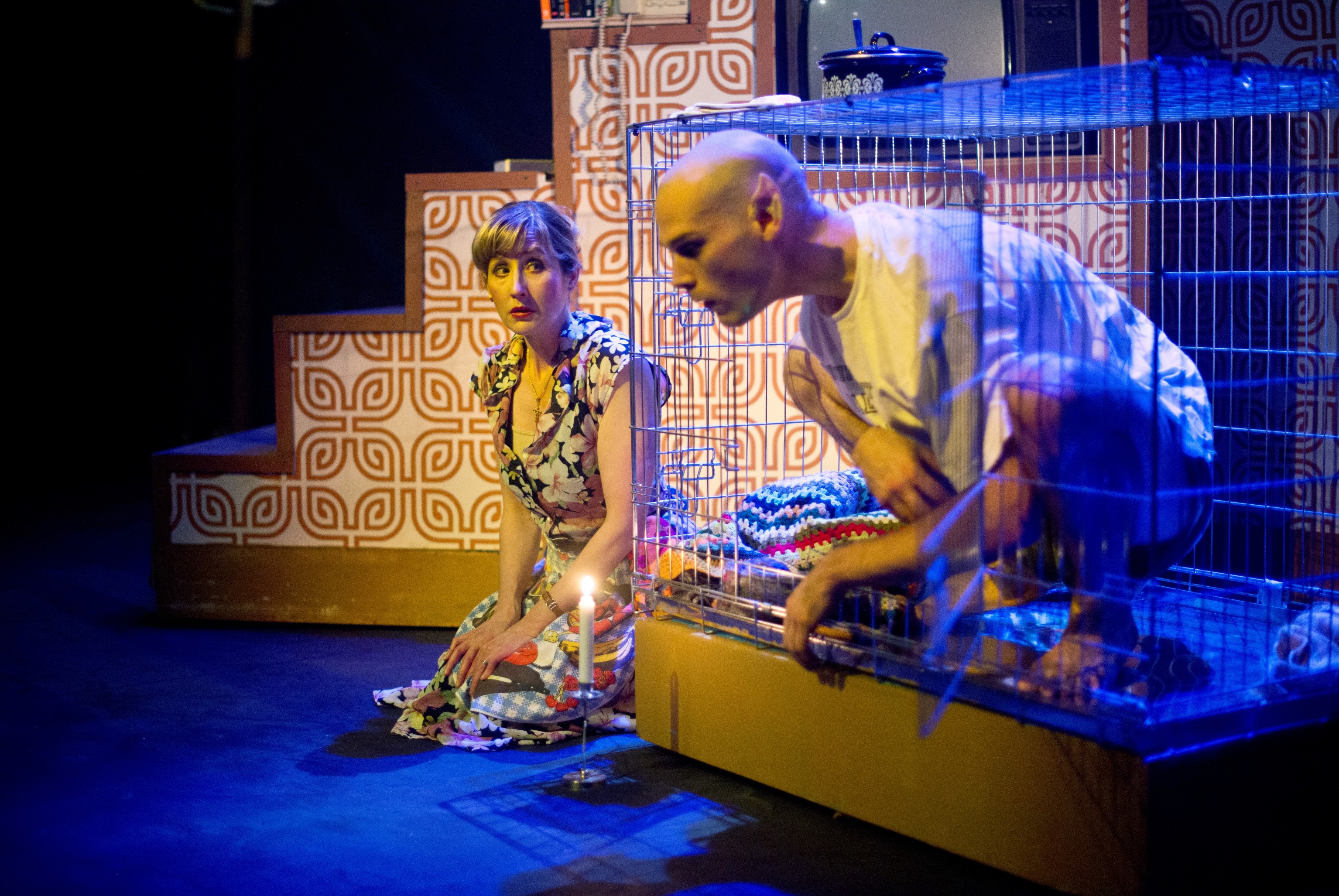
What makes something a monster? A small town in America finds an unlikely creature in its midst when, after an attack, a wild boy is dragged from the cave he grew up in and brought into the town to be put down by the local vet, Dr. Parker.

Edgar is a cross-species creature somewhere between human and bat – not by choice and without a Batmobile – and he brings out the best and the worst in the Parker family and the rest of the inept hillbilly villagers. A lot of strain is placed on the family bonds with daughter Shelley (Georgina Hagen) initially resenting and then slowly warming to Edgar and Dr. Parker caught between the public pressure to kill the beast and the wish to please his cold-shouldered wife who has mysteriously rather taken to the boy. Murderous and forbidden desires have everyone picking up their stakes and baring their metaphorical fangs.

A ramshackle aesthetic – intentionally bad wigs married with gothic sentimentality and overblown video art installation-style projections – meant that a touch of consistency was lacking from this freak-as-hero tale. Relishing the joyful quirkiness of Keythe Farley and Brian Flemming’s book Morphic Graffiti‘s take on the 1997 US cult musical Bat Boy it was sad to see the production get lost somewhere along the way between South Park and Twin Peaks. Stewart Charlesworth’s knowingly kitsch design package that wrapped around the whole piece never quite caught up with the promise of the gorgeous-looking tumblr fest of the overture, which was awash with references to Robin Thicke and Star Wars. Bat Boy has a slow-moving first act with too few really outstanding moments. As soon as Rob Compton leaves behind his exquisitely creepy Gollum-like physicality and turns into a proper young gentleman, complete with polite RP accent, the questions is: where is the horror hiding? Is it in the happy-clappy religious fanaticism of small-town narrow-mindedness or maybe in the inevitability of past errors playing catch-up?

With the gospel-like ‘Comfort and Joy’ and a spot-on comedy performance by Simon Bailey as Reverend Hightower, the second act gets rid of the safety breaks early on and in doing so reveals how unfocussed the first act was. Most of the cast did not struggle to deliver Laurence O’Keefe’s high-soaring tunes although the music relied too much on for-effect-only sustained high final notes to be actually catchy. Lauren Ward hit all the sweet spots in her solo scenes and even more so when in duet with Compton’s Edgar, their convincing chemistry giving way to some soaring moments.

Other aspects of the production lack that level of conviction. Too many things are just that tiny bit off: the trash was not crisp enough to be consistently amusing, the light too sluggish and the soundscape somewhat dulled. More precision and faith in the silliness of the material would have lent more stylistic integrity to the whole show.

Bat Boy has something of a cult following and for fans this production presents a rare chance to see the piece in London. But for those who are drawn to it for its mixture of the bizarre and the outrageous, as well as its send up of religion, Book of Mormon might still be a better bet.

Mush and Me

Muslim boy meets Jewish girl. Mush is loud. Gabrielle is clever. She’s too good for that job in the call centre. He’s cocky. She’s intrigued. And why wouldn’t she be interested in someone who teases her with charming lines such as “Don’t take the piss out of my prophet, you slag”? Actually, I meant, why on earth would she be? Beats me.
The premise of Mush and Me is perfect romantic comedy material. Good thing Mush turns out to be a bit smarter than he initially seems, with performer David Mumeni infusing a lot of warmth into the role of the obnoxious but lovable character.

The two start bonding over food: good hummus, forbidden pork and a romantic fast-breaking on the beach. And then they argue playfully about the differences in their religions with their shared origins but wildly differing practices. The show’s interfaith relationship focus taps into very recent discussions around events of religiously motivated military conflicts and how personal stories of people around the world are impacted by them. Misgivings seep into moments of intimacy and family expectations cloud ideas of a shared future.

Writer Karla Crome has a screenwriter’s ear for sharp dialogue. She knows how to deftly twist genre stereotypes of rom com storytelling around the central issue, although stylistically there’s nothing revelatory or subtle in this play. When funny it elicits belly laughter from the whole audience but when it turns sincere it doesn’t quite pack a punch. It’s never quite clear what these lovers have to loose apart from their parents’ approval. This is, granted, no small issue but the way this conflict is negotiated never takes off to any particularly relevant heights.

During the scene changes we see the two practice their religious rituals in dignified silence and then hear interview recordings from real life interfaith couples hovering over that. These subtly lit interjections feel like an attempt to romanticise and lessen the hardship that religious dogma inflicts on the lovers.

Rather surprisingly it’s the idea that love should conquer all that doesn’t quite come into its own here. When Mush accuses her of cowardly hiding him from her family he doesn’t seem to be aware of the pressure on a woman in an interfaith relationship and then he goes on to exert some more. As the play progresses the initially strong and clever Gabby gets
taken down a peg or two and through her involvement with Mush looses some of her agency. Should she tell her dying father about Mush? Why is this God she doesn’t even believe in cruel? These are personal struggles projected against a dogmatic canvas. Danielle Isaacs plays Gabby’s journey with the urgency needed when competing with the zingers dished out by her male counterpart.

 Mush and Me – part of the RADAR festival at the Bush – is sincere in its sentiments, well acted and has two well-rounded characters at its centre but crucially it fails to tell us anything new; the importance of tolerance and open-mindedness in interfaith encounters is something, however, that bears repeating.

Theatre Uncut 2014

I consume politics like I consume food. On a regular basis and in any format I like. I like my eggs scrambled and my reading in the form of mildly outraged Guardian articles from a carefully curated Twitter stream. There I can exchange snarky comments with other like-minded people and if someone threatens my belief system I block them. For example, when I tweeted an article about Mike Brown the other day and someone accused me of white racism I blocked them because I couldn’t see the point in arguing with trolls and it was late in the night anyway. And when the next day comes along there is always one more new thing that’s wrong with the world. Any seed of activism that might have reared its head is buried under an avalanche of new disaster: the bashing of the working class, misogynistic perpetrators getting more media attention than the victims of their crimes.

During this latest incarnation of Theatre Uncut project at Soho Theatre, the four performers stand in front of me like a wall, facing the audience. This is something I can’t fast forward or skim-read. Clara Brennan’s _PACHAMAMA_ is a defiant act in the face of an overwhelming onslaught of information. A mother (Ruth Gibson) is transformed into a mighty Mother Earth creature. Drawing on an Inca myth it’s a sudden twist which is naturalised beautifully by the flow of words. No miming or props involves, just words weaving, heaving and moving forward – and she’s off, this surreal goddess. She has the monstrous power to shatter problematic configurations of nation states and plant them somewhere else on the planet. She can stop natural catastrophes or health epidemics being hijacked for political purposes. It’s a poetic, overpowering and empowering play which suggests we might not have to worship the god of Capital.

It is hard to conceive of a theatre project that wears its politics so clearly on its sleeve as Theatre Uncut. Born in 2010 as an attempt to respond to massive cuts in arts funding the project is now in its fourth year. This year there’s a tour around the UK and one month of mass action in which people from all over the world gain the rights to perform and transform the five pieces of new writing in any way they see fit. Within their means Theatre Uncut practice what they preach: the plays are free to perform and translators and theatre makers are given structured support to create their work. Theatre Uncut makes an effort to open up the system it is critiquing from within, both in a performance and producing model. The marriage of theatre and activism has always been a potent one after all.

Anders Lustgarten goes for satire in his Charlie Brooker-ish The Finger of God, which mocks the notion of progress and unsustainable growth. When a politician and a lottery executive discuss how to make playing the lottery more appealing to the masses again the progression into megalomania cuts right to the core. All the pieces are directed by Theatre Uncut’s artistic director Hannah Price and she uses the gorgeous set by Carla Goodman with its flexible boxes and inset lighting elements to great comedic effect. The hatred of the poor, so urgently examined in Owen Jones’ Chavs, finds its outlet when a gladiatorial twist on the Lottery system, which turns everything into a dark dystopia in which the rich make the rules but do not abide by them. Sound familiar?

Ira Provitt and The Man is Hayles Squires’ play about a policy makers whose proposed education reform threatens to transform the lives of a future generation into a numb mass. Results are all that matters, the weak fall behind. The piece looks at the degeneration of ideals and what chance there might be to recover them. Plagued by a personified conscience Ruairi Conaghan plays the eponymous Provitt as someone whose buried ideals are reluctantly at odds with the expectations of a society intent only on aspiration. If not treated carefully the education system might stop planting the seeds that enable us to act as compassionate human beings. Some might say that in some instances this has already happened and if Squires’ approach comes across as rather quixotic that might say more about my own cynicism than her piece.

Political lethargy is partly fuelled by the sense of being overwhelmed, that everything is too fucked up too fix. Inua Ellams’ Reset Everything plays with the idea of wiping the slate clean. If you can’t afford the house because of the newly introduced bedroom tax you might as well blow it up, the characters seem to think in this absurdist short. The play features a conservative anarchist, a tax inspector hidden in a cupboard, and lovelorn young man (Conor MacNeill) comically trying to fix the plunger of an oversized bomb in the middle of the room: it’s not necessarily subtle but it’s fun and provocative nonetheless.

Obfuscation of information plays a big part in the apparent political complacency of the people. The role of the media can never be underestimated too much in this context. Vivienne Franzmann’s contribution discusses how the entertainment industry robs us of our ability to engage critically with complex figurations of society. In The Most Horrific a couple sits in front of the telly and as they watch they exchange lukewarm half-truths and half-opinions about what’s going on in the world behind that screen. Global warming, banking crisis and motor neurone disease – the two don’t have the strength to be properly outraged. Can we get that in a social media-friendly and easily digestible wrapping so we can engage with it, please? In their near vegetative state they crave nothing but closure and diversion.

This is framed by a man and a woman at a comedy stand-up audition. She tries out jokes, he rates them for funniness on a flip chart with Yes or No columns. Faith Alabi, who makes a stunning professional theatre debut here, desperately clasps the microphone as she rattles off one catastrophe after another in a familiar joke format. She becomes increasingly distressed as none of her lines make it into the Yes column. It’s a glum analysis of how the problems of our society tend to be consumed like products or food. Franzmann’s deceptively simple structure makes clear that responsibility lies with media and viewers alike.
Theatre Uncut transfers the onslaught of bad news (“everything that is wrong with the world” as one of the writers put it in the talkback session) into a format that partially breaks it out of gridlocked consuming patterns. It extends an unrestricted invitation to participate through performance.

The World Mouse Plague

Annegret: A post-structuralist walks into a theatre, picks up the flyer for Ridiculusmus’ new piece, studies it and then leaves again. He only watches plays by dead authors.

Seriously though, can we talk meta? Your review mentions “meta-theatrical narrative and structure”, “feedback loops” and “meta-layers”? I think Catherine Love had a point in her look at the piece… how clever-clever can a play be without alienating the audience. I can picture someone being utterly bewildered and disappointed. I mean, enough already with the Punchdrunk jokes.

Tim: Meta is always better. I like the bewildering effect of being faced with a play that gets a bit beyond itself, a bit beyond me. Ridiculusmus really nailed it here. I agree that it could be alienating – the performance mentioned at least two other shows that are on at Battersea Arts Centre at the moment, as well as Punchdrunk etc. Still, I got the jokes, I enjoyed it (emphasis on the ‘I’).

Annegret: I like metatextual ponderings as much as the next critic but this kind of thing is why people got cross with Derrida’s idea around text and authorship. Eroding these fundamentals is alienating. Not that I didn’t enjoy it mightily but I do wonder what the ceiling is for rolling commentary and narrative into one big fur ball and vomiting it out in front of the audience?

Tim: Honestly, the reason I focused on the show’s meta-narratival aspect is because I didn’t pick up on the political point. Your review says the show is ‘surprisingly firm in its moral stance on role of the artist in the gentrification process’. I totally missed that. Billy Barrett’s brilliant review is almost entirely about that theme. He says Ridiculusmus (deliberately) portray themselves as a company “wilfully ignorant of the damage wrought by its own practice”, that art is a cause of ‘gentrification’ (a word that you and Catherine Love both use) as much as it wants to be the effect. I liked the flash of its endlessly peeling structure and missed the deeper point…

Annegret: I’m not sure I agree that you missed the point. Maybe there is just not much left to chuck in the pan to fry when you’re done with the peeling?

Tim: Even if it hit the theatrical in-jokes a bit too hard, it was still clever-clever. Have you seen that Doctor Who episode where Clara jumps into the Doctor’s timeline and spews herself into various episodes across his many incarnations? WMP was like that. The performers play different characters in each little scene, commenting on it as they do, but in each scene is the common element, the Clara factor, that they are always dressed as mice. And they almost always refer to being dressed as mice.

Annegret: I’m really glad of that analogy because not only have I seen that episode I also think it illustrates my problem with the piece. You know how the “Impossible Girl” Clara is nothing more than a mystery to the Doctor? Something that needs solving? We don’t really care for her as a character. She’s just there, doing all this awesome timeline jumping stuff and baking soufflés but she doesn’t have a personality of her own. I don’t want to sound like a grumpy Scot here but I’m really wondering what this piece is trying to do apart from the layering? It encodes its message (and I use that word with a curled upper lip) so heavily that it kind of betrays whatever commitment it makes to social commentary. I still wouldn’t go so far to say that it only leaves me with “spiteful laughter” as Larry Bartleet states in his review for Broadway Baby when the show was up in Edinburgh. I would argue the satire doesn’t sting enough.

Tim: But I think that the substance is there. That substance comes partly from the cleverness of the form (the layered structure, the sketch-like presentation), and partly from the variety of the content, what those sketches are actually trying to say. Which, I think, is some kind of typical Doctor Who ending about being nice to each other and how brilliant the human spirit is etc…

Annegret: I’m not saying that there was no human drama in The World Mouse Plague and I’m biting back the inverted commas around the word human here because these mice, man, they were literally running for their life. As an allegory when it wasn’t all jokey it was actually quite powerful. Maybe I’m just contradicting myself here or the play is both about these themes and at the same time isn’t. Insert an idiotic Schrödinger’s cat remark here.

Tim: It’s exactly as you say – there’s human drama in there, but it’s cloaked in silliness. I don’t think that’s a bad thing. The drama that these ‘mice’ face is very human, played out in varying degrees of metaphor: Mrs Runacres-Watt’s eviction is a real life example, but when the mice nibble at the poisoned cake and die (you can imagine River Song crooning the word ‘spoilers’ here) that’s the same narrative – being fucked over by someone else’s cruelty/insensitivity – in a more metaphorical form.

Annegret: The spoilery scene is actually the most powerful for me. Not because of the tragic height but because the surprisingly focused lighting and the suddenly swelling, soppy music which hadn’t been used in the piece before. The way it was done was an obvious comment on traditional theatre conventions and on how the tools of theatre are regularly used to manipulate audience emotions. It was deeply affecting, quite clearly marking me as an immersed audience member, but in the same moment I was also aware what was being done to me. But let’s leave Brecht in peace, shall we?

Tim: Yeah, definitely leave Brecht in peace! What WMP shows is that something as simple as a mouse costume can be hugely multivalent and deeply symbolic. As a symbol, not to get too Barthesian about this, mice represent an odd combination of ’the oppressed’, of a cartoonish silliness, and of a sense of pluckiness. Mickey Mouse was, basically, the first animation. Then, as you mention in your review, comes Tom and Jerry. And Dangermouse, Pinky and the Brain, Rastamouse…All these little mice are always running for their lives, and they are always fighting back. Some of that embedded symbolism must have seeped through in my interpretation of the piece and in my attempt to understand what the mice costumes were about.

Annegret: Actually no, let’s get Barthesian about it! We have come this far. The whole thing seems to me then as with so many good pop culture products (see The Simpsons) a matter of how much effort you put into decoding it. Barthes distinguishes between readerly (easy to understand) and writerly texts (hard to understand – you have to “write” the meaning yourself). With texts he means any cultural offering that can be read, so not just books.

And the success of that effort is always determined by how much you bring to it. You call that process “seeping through”, I’d call that being a critic who doesn’t just say “I didn’t get it therefore it must be rubbish”. If only I had watched Dangermouse then it all would have made more sense. I’m not trying to be flippant here by the way. You’re basically saying there’s a whole level that works as incitement to fight back against the things that oppress us. That’s quite spectacular. And it’s definitely in there but only if you can access the Mouse reference frame you opened up.

So, what are you seeing next?

Tim: Cats.