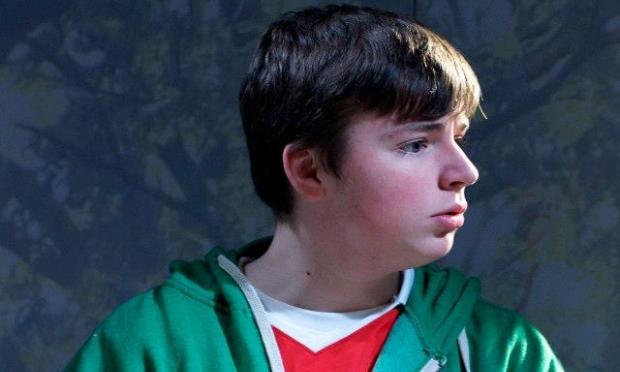
Fifty Shades of Meander: Aftercare at the White Bear Theatre

Diving deep into the murky, psychological realms of human sexuality, Steve Lambert’s play Aftercare centres around three people in the BDSM scene who have developed a twisted, codependent relationship with each other. But for a piece that’s all about blood play and cutting, the play is nowhere near as edgy or engaging as it should be. At the White Bear Theatre.

Sam, a young woman whose life is dulled by a soul-sucking managerial job, seeks out the company of Paul and submits to his sadomasochistic treatments. At first shocked by the experience, she soon develops a taste for the pain that has renewed her senses and perception of the world. She demands an even harsher and more painful treatment with long-lasting effects. But Paul, who has a history as a submissive, finds himself unable to cater to Sam’s needs. He is still under the spell of his old mistress Lisa (Claire Louise Amias) who has literally scarred him for life. Suffice to say, this show is not for the squeamish.

At its heart, the play asks how relationships really work and why we seek them out even though a lot of them are bound to end in self-compromise, disappointment or even pain. Is it the sadomasochistic side of relationships that a lot of people actually crave? There are many facets to BDSM, and the play appears to be much truer in its depiction of submissive and dominant behaviour than E.L. James’ ubiquitous Fifty Shades saga. Without glorifying or sugarcoating anything, Lambert’s play shows how physical sacrifice and subordination take precedence over personal proximity and emotional support.

If only it were more interesting to watch. It takes quite a while to warm to the characters and then after motivations and conflicts have been introduced, the piece meanders aimlessly without ever going anywhere. I could swear that at some point the author has somehow managed to make a connection between a committed relationship and human vampirism, but then I can’t be entirely sure because somewhere between litanies about who drinks whose blood and the pointless passing around of a razor I lost interest in the characters.

Giles Chiplin’s set is a grungy-looking background with a bench that, later on, when the play’s setting changes into a derelict church, serves as a coffin-like structure. The practical set toned down to a bare minimum would have served more purposeful performers as a space to lay open the psychological scope of utterly dominating or being dominated by another human being. But at times it just felt like the actors were only saying the dialogue and were not really inhabiting the character. Basil Stephenson sometimes gets lost on the tiny stage of the White Bear, so unfocussed is his Paul that at times he seems to unconsciously contradict what is being said in the script. A bold choice by Vanessa Russell to choose Aftercare as her debut stage performance, and she certainly plays SM novice Sam with conviction and the right mix of innocence and eagerness.

However, on the whole it simply wasn’t an interesting watch – not sexy enough to spark any primal desire and the build-up to key scenes wasn’t tense enough to make me care. There certainly is a bold, well-researched idea in there somewhere, but the execution left me completely cold. Some of the more interesting aspects about religion being touched on in the play are unfortunately not explored further.

Unholy night: Merrie Hell at the Soho Theatre

For some people Christmas time is the best time of the year, but drag performance legend David Hoyle has, of course, seen through the sanctimonious facade of our consumer culture and sets out to show his audience the dark side of Christmas. At the Soho Theatre.

For some people Christmas time is the best time of the year. It’s all so very special: candles and glittery lights everywhere, the smell of mulled wine at the markets and lovingly picking presents for the special people in your life. Drag performance legend David Hoyle has, of course, seen through the sanctimonious facade of our consumer culture and, with a song on his lips and red baubles dangling from his hips, he sets out to show his audience the dark side of Christmas.

But he is no ordinary Scrooge, as together with musician Richard Thomas he merrily flips off various shades of heteronormative hypocrisy to make people aware that society usually demands of them to be a cruel and insensitive “mix between a moron and robot” to succeed.

The show starts with a weird, inclusive song proclaiming that “We’re All In This Together”, and I wondered if I’ve accidentally stepped into a special Soho High School Musical adaptation but I need not have worried too long. Gays in the military, male sexual domination, religion – everything gets a quick once over, if you catch my drift.

The focus of the show is clearly on Hoyle, with no set on the stage and only a macabre Christmas tree to set the mood for the evening. Richard Thomas, who is the stooge behind the piano, comes across a bit laboured at times when he gives the cues to prompt the next song-clad rant. But he seems to be enjoying himself watching Hoyle being cynical while belting out lyrics that make the audience gasp. The songs are funny but more than just a little caustic. To say that this show is not really suited for the light-hearted would be like saying that heroin is not quite suited to cure sleeplessness. But better leave the absurd similes to Hoyle, who, for example, thinks you’d be “Better Off Dead” if you’ve never heard of German revolutionary socialist Rosa Luxemburg.

And here is the surprising thing about the evening: although the set-up could very easily just have been a guy in women’s clothes ranting about Christmas and trying to earn some cheap laughs, Hoyle and Thomas dig deeper and only make it look like a cheap laugh. It’s a simple dramatic strategy, using contrasts not to shock, but to point out what is actually shocking in society. Ergo, the song about suicide clearly needed to be spiced up with a tap dance routine.

Sadly, most of the songs are a slightly forgettable, and I must admit that I expected a bit more finesse from Thomas, who in the past wrote the music to Jerry Springer – The Opera. But all in all it’s fun to see a show in which, for once, one does not care the slightest bit about political correctness and has cocky audience interaction.

This cabaret show does a good job with taking its audience on a slow descent into hell. And did I mention that it’s not for the easily offended? Although, that being said, mentions of bestiality and necrophilia should not stop you if you like your entertainment clever, queer and thought-provoking.


Dog food, penis pumps and jello: The Changeling at the Young Vic

Outrageously funny, creepy and filled to the brim with innuendos and openly sexual scenes, Joe Hill-Gibbins’ interpretation of The Changeling makes it very hard to believe that the play was written nearly 400 years ago. At the Young Vic.

It seems like a perfectly straight-forward setup for royal intrigues and misunderstandings: Beatrice is just about to be married off by her father to a man she does not love. Just then, she catches the interest of young Alsemero, and so the daughter of the house decides that a good-looking fellow like that is well worth sinning for. But the conundrum is, of course, that she doesn’t really want to get her hands dirty while ridding herself of the unfavourable future husband. So she turns to the one person on court she utterly despises and feares and makes a deal that’s based utterly on a grave misunderstanding. What starts innocently enough in a church turns quickly into an absurd bath – not just of blood, but of all sorts of bodily liquids, smelly pulps and excessive trifle.

The main plot is supplemented by a story set in a madhouse – and in this piece, William Rowley’s contribution to Thomas Middleton’s piece is a cleverly distorted and grotesque mirror of the main story at court. The moral demise of the characters and absurd situations they put themselves through resonate with many topics relevant today: especially the connection between male, political authority and the power that is being exerted over women’s bodies.

The space that has to serve as a castle and an insane asylum at the same time resembles a big gymnasium, with blue sport mats and one of those big nets that keeps audiences from being hit by ricocheting balls. It’s a daring way of creating theatre in the round that experiments with different seating options for the audience, but one that also has a distinct drawback for approximately half of the audience. It is actually quite irritating being forced to watch a play through this net for two hours straight and it detaches the viewer from the action on stage. I know that this is probably the point of the whole thing, so well done to the design team (Ultz, who was responsible for the design of the much-discussed Jerusalem) for actually reading Brecht and shoving an alienating device in my face. I would imagine the play would be a whole different experience if you manage to get a seat in the commentary box-like structure very close to the jello-laden action that’s always a tad too creepy to actually be sumptious.

So yes, after moving the play from the smaller Maria Studio (where the play had a run at the beginning of this year), the space and the stage in the main house are a bit too wide to allow the viewer proper submersion into the story. Nonetheless, it’s a masterclass in visually irreverent theatrical design, because the messiness it creates is never pointless. My favourite visual joke involves three different coloured puddings being smeared over in ecstasy writhing bodies.

The fourth act is a disjointed beast, but the director still manages to get a fairly good grip on it, and the excellent actors help to reign the piece in even when the plots weakens slightly. Zubin Varla, who earlier this year could be seen in Don Juan Comes Back From The War at the Finborough, returns in an equally visceral role, but here, with his flakey forehead, he is more of an anti-Don Juan. He plays pitiful and facially disfigured de Flores, who is taking advantage of Beatrice. Sinead Matthews plays the tragic leading lady as a slightly sneaky woman who is all too ready to give up moral standards to achieve her goals, but who is also forced by the men in her life to act in exactly that way. Harry Hadden-Paton’s Alsemero is a bit of wide-eyed drip who never seems to realise that his actions (and proclivities) have caused many the conflicts in the first place.

It’s exciting to watch; intellectual and raw at the same time, with convincing performances that lack any modesty. Although, the number of times I have heard Beyoncé’s Single Ladies used on stage to comment on a play’s sexual politics… I can assure all burgeoning directors and designers that this device has now definitely run its course, but this piece wins the prize for the most mischievous and sardonic use of it.

Helplessly tackled: Where The Mangrove Grows at Theatre503

Children abandoned by their parents and left at the mercy of carers who are not suited to deal with difficult behavioural problems are no longer a blind spot of society. This co-production with Number Nine Theatre proves that the Theatre503 is a place where new writing talent can showcase their work, but in this production an important topic is tackled rather helplessly.

Children abandoned by their parents and left at the mercy of carers who are not suited to deal with difficult behavioural problems are no longer a blind spot of society. This co-production with Number Nine Theatre proves that the Theatre503 is a place where new writing talent can showcase their work, but in this production an important topic is tackled rather helplessly.

Sean is a 13-year-old boy who lives in a bare room in a children’s home. As is often the case with children of that age, the authorities have difficulties in finding him a place in a foster family. To dream himself away from the constant disappointment of his young life, he seeks solace in a very specific book about a world that couldn’t be further away from his reality. Despite having been abandoned by his mother, he has kept his childlike ability to dream himself away into fantasy worlds in which oak trees turn into exotic and magical mangroves. A motif that’s neither subtle nor particularly interesting, the mangrove right outside his window signifies a dream world he can escape into. Here in the swamps of an undefined African country, a black man by the name of Charles lives with his big and jolly family. As a writer, letting an exoticism like this actually come to life on stage is a stylistic decision that is questionable at the best of times. Here too it feels oddly dated when Sean’s fantasy manifests itself in the form of Mark Springer’s simple-minded Charles.

The performers were convincing on the whole and did the best they could with the material. EastEnders’ Charlie Jones, who is known for playing Ben Mitchell in the soap, is the young main character and constant focus of the production. It took me a while to warm to his portrayal of Sean, but very soon there was much more to the boy than just a truculent brat when he gets to express adorable childish joy when the clunky metaphor for a better life literally blows into the window in the form if a couple of oak leaves. Jones’ performance turns out to be nicely layered – certainly an achievement for an only 16-year-old performer.

David Birrell plays Sean’s carer Mike with the attitude of a disillusioned, sad custodian who has serious anger management issues. Totally unfit to take care of a child who has to cope with having gone through domestic abuse, Mike is in constant battle with himself. He is frustrated with his incapability to fully gain Sean’s trust or control the child’s unruly behaviour. But when we see Sean interact with Charles later on, we become aware as an audience that he is not actually mentally unbalanced. Something else must stand between Mike and Sean that prevents a connection from forming. When Mike, the person who is entrusted with fixing Sean’s problems, claims that families are not everything they’re cranked up to be, a whole realm of topics so hotly discussed in relation to child neglect get touched upon. Unfortunately the dialogue lacks a certain depth, it’s all discussed but not illustrated believably in the character’s actions.

The set is practical but also slightly uninspired, especially for a play that sets out to invoke the escapist fantasies of its main character. A wooden frame around the whole proscenium remains just as puzzling as a creative choice as the black nothingness of the window and both don’t work particularly well with the rather unsupportive lighting.

According to Joe Hammond, writing this play has been a very personal process of coming to terms with the time he worked in a children’s psychiatric hospital as a young man. What a shame then that this play lacks a certain finesse that allows for audiences to engage in the characters and their story arc.

What from the outset could have been a promising examination of the vicious circle of abuse turns a bit hackneyed, and the ultimate twist of the story may indeed be surprising, but not necessarily in a good way.