TT 17 Feature

With its heady mix of radical work and discussions on the future of art and the creative process, Berlin’s Theatertreffen is always a politically charged affair. Annegret Märten meets organisers and attendees of the festival to explore how international affairs are making their mark on the German-speaking theatre ecosystem.

Berlin’s Theatertreffen has always been a political affair, but the tone differs from year to year. In 2015, when Germany’s Angela Merkel opened the country’s borders to 800,000 refugees, Theatertreffen opened with a heavily discussed Nicolas Stemann production of Elfriede Jelinek’s reworking of Aeschylus’ The Supplicants, but this year post-migrant voices were virtually absent. While the festival opened with Simon Stone’s millennial reworking of Chekhov’s Three Sisters, the theme of political engagement remained a recurring theme throughout the 16-day festival.

At the heart of Theatertreffen is a selection of 10 shows that a jury of experts have deemed ‘notable’ – a nebulous term that is reinterpreted each year. From the outside, the festival can seem an elitist enterprise: tickets are hard to come by and sell out within a few hours, while the discussion and audience events often revolve around aesthetic forms and the political responsibility of art. However, Theatertreffen has always challenged production modes and forms of representation on stages in the German-speaking world and beyond. As such, it seeks to foster upcoming talent while grappling with problems that theatre currently faces.

The new writing segment Stückemarkt, for example, showcases radical theatre from across Europe. This is the forum to which Simon Stephens invited Chris Thorpe’s There Has Possibly Been an Incident in 2014. This year, however, the pieces presented at Stückemarkt largely avoided the refugee crisis. Petra Hulova’s Cell Number looks at Czech national identity, while Rainer Merkel’s Run and Bring Us Your Naked Life addresses colonialism and Tanja Šljivar’s We Are the One Our Parents Warned Us About is a touching exploration of grief.

Diana Insel, organiser of the Stückemarkt, says that themes such as populism and national identity were high on the agenda: “Borders were a huge topic, although, perhaps surprisingly, not many of the writers’ submissions focused directly on refugee experiences. Instead, the approaches to the current crisis were mostly filtered through personal lenses.”

The winning Stuckemarkt piece, The Growling of the Milky Way by Bonn Park, is an affirmative feat of wishful thinking that projects visions of a better world on to public figures such as Kim Jong-un and Heidi Klum. Another intriguing contribution, Who Cares?! by the company Swoosh Lieu, challenged the invisible nature of female care-workers.

The spotlight on the work of collectives such as Forced Entertainment, She She Pop and Familie Floz led to discussions about changing methods of production in theatre: how can international production structures work within the locally focused German city theatre model?

Festival director Yvonne Büdenhölzer and Berliner Festspiele director Thomas Oberender have questioned whether the trend towards international co-productions of the invited shows with directors such as Thom Luz (Theatre Vidy Lausanne) and Milo Rau (International Institute of Political Murder/Campo Gent) signals the end of the repertory theatre system.

Their conclusion that this is not the case was cast into doubt when the upcoming season at the Volksbühne, one of Germany’s most experimental ensemble repertory theatres, was announced during the festival. This was the latest turn of events in the hotly disputed takeover of the theatre from long-standing artistic director Frank Castorf by former Tate Modern director Chris Dercon. While the 2017/18 season features many co-productions, many of them, controversially, will not originate at the Volksbühne. Dercon’s idea of theatre is a much more open concept of performance that includes dance, film and even game formats.

His many critics are worried that the festival-like curated approach to programming endangers the fragile ensemble model as well as the subversive aesthetic cultivated under Castorf’s quarter-century reign. Local audiences might adapt to these changes quickly, but it remains to be seen whether the Volksbühne will retain its famed political and artistic explosiveness.

5 things you need to know about Berliner Theatertreffen

1. The first Theatertreffen took place in 1964. Meaning ‘theatre encounter’, it is produced by the Berliner Festspiele, a body funded by the national Federal Cultural Foundation.

2. Every year a jury selects ten notable shows from hundreds of productions from the German-speaking world – there is no single winner.

3. Other awards are also handed out alongside this. The 3sat Prize for an artistically innovative achievement was handed this year to director Milo Rau who was invited with his show Five Easy Pieces. The Theatre Prize Berlin went to Herbert Fritsch for services to German-language theatre and the Alfred Kerr Acting Award went to Michael Wächter.

4. In 1978, the Stückemarkt was introduced as a way of discovering new writing talent from across Europe. Since 2012 it has focused on exploring new forms of authorship.

5. The International Forum is a platform for up-and-coming theatre practitioners that enables them to see the invited plays and take part in workshops.

Knurren
Das Knurren der Milchstraße Reading

Another segment at the festival is the International Forum, to which UK theatre-maker Ira Brand, co-artistic director of Forest Fringe, was invited this year. The forum is a platform for exchange between performers, dramaturgs and directors from more than 20 countries. Activities include workshops and talks as well as the opportunity to engage with different theatre ecologies.

Brand reflected on some of the differences she had noticed: “At the International Forum there are people from all over the world. Here in Germany, people really seem to have to stake out their roles and say ‘I’m a director’ or ‘I’m a writer’. Perhaps this has to do with a difference between working within the state theatre structure or bigger institutions and working as an independent artist, as is my background.”

A key difference, says Brand, is the figure of the dramaturg, whose role in German theatre institutions is to facilitate dialogue around the work. “There is a readiness here to accept that the work can’t answer or even pose all the questions and I don’t see this so much in the UK. It does happen, but in many theatres, curation is more about programming work that fits under a particular theme.”

For Brand, the collective scrutiny of the International Forum has thrown up questions about representation which the makers of the big shows might find difficult to address from within their own production contexts.

“I feel a peculiar distance to the shows I see here on the big stages in relation to my own practice,” she says. “The discussions we were having in the International Forum often revolved around identity, position and voice. Who’s speaking here and who isn’t. It was interesting to witness the very different approaches that are taken with regard to questions of diversity.”

This critical counterpoint to the main programme is consciously built in, according to Daniel Richter, who is the organiser of the International Forum: “Our objective is to connect the German-language work that can be seen here with an international context and to establish spaces where knowledge and experiences can circulate.”

One of the many formats trying to extend this exchange to the public was the accompanying conference, Art of Democracy. Theatertreffen uses its public platforms to show solidarity with artists whose works have pointed at the fractures and shifting grounds in European democratic models.

For example, Croatian director Oliver Frljić, who has been viciously attacked in the past for his controversial work, talked about freedom of speech. Falk Richter, whose 2015 work Fear at Berlin’s Schaubuhne faced protests and legal action from the burgeoning German far right, was invited to reflect on identity politics and current threats to plurality.

The spectre of globalisation has long been knocking on the doors of Europe’s theatres. Now it appears to have found its way inside.

Profile: Theatertreffen

Artistic director: Yvonne Büdenhölzer
Stuckemarkt director: Diana Insel
International forum director: Daniel Richter
Location: Berlin, Germany
Founded: 1964
Performances and events: 10 invitations, Five international co-productions with the Goethe Institute, Six pieces of new writing at the Stückemarkt, Other events include VR installations, workshops, artistic interventions, conference, films, concerts and discussion platforms
Audience numbers (2017): 17,700 over 16 days on five stages and event locations
Funding: Kulturstiftung des Bundes (Federal Cultural Foundation) – €1.9 million (£1.65 million) per year

Originally written for The Stage.

Professor Bernhardi Schaubühne

When he turns away a Catholic priest from a delusional dying girl, esteemed director of a private clinic, the Jewish Professor Bernhardi staggers unwittingly into a political affair.

His selfish peers manipulate facts to whip up a scandal and play off latent anti-Semitic resentments. What begins as a small confrontation between two men culminates in the ruin of the doctor’s reputation.

While his cast of 16 shines, particularly in the production’s rare slapstick moments, Thomas Ostermeier’s overwhelmingly naturalistic direction of Schnitzler’s 1912 tragic comedy, feels like a dry autopsy of the scandal, albeit a timely one.

In a return to the Schaubühne ensemble, Jörg Hartmann – an audience favourite who plays a bedraggled detective in the long-running TV police drama, Tatort – plays the title role, meeting the political farce playing out around him with aloof smiles and amused exasperation. In contrast, there is little elegance to the self-serving antagonists with Sebastian Schwarz leading the pack as the slimy, nepotistic Ebenwald.

In dramaturg Florian Borchmeyer’s updated version, the self-important pompousness with which the schemers reassure themselves of their own authority is matched by clarity of plot. In many long conversations, staged on Jan Pappelbaum’s plain paper-white set, the piece explores how relying on common sense often fails as a strategy when it comes to shocking distortions of public discourse.

The overall static feel of the show is broken up by Katharina Ziemke’s painting. She scrawls on the sterile white walls of the set – complete with hand sanitiser – a metaphor for the messy processes that are at work in a post-truth society.

Originally published in The Stage.

Featured: Visual Monsterisation Strategies

Monsters thrive in the messy swamps of pop culture. They live in the fertile space where classic literary narratives and traditional aesthetic norms are blown apart by visual strategies. They are born at the crossroads between political turmoil and contemporary taste. The particularly adversarial climate of the current American Presidential election campaign proves that monsters are nourished by culture’s incessant need for new imagery.

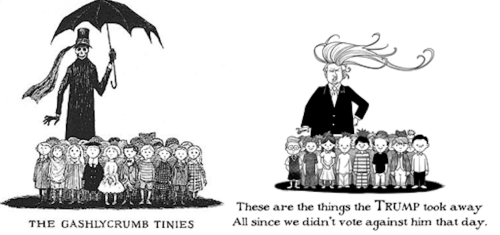
In an example from a couple of weeks ago, game designer Mike Selinker worked with several illustrators to produce an adaptation of the well known ABC book The Gashlycrumb Tinies by Edward Gorey. The original 1963 illustrated book is an assembly of macabre pictures about children meeting their unfortunate ends through such creative mishaps as being “sucked dry by a leech” or being “devoured by mice”.

Gorey Trump

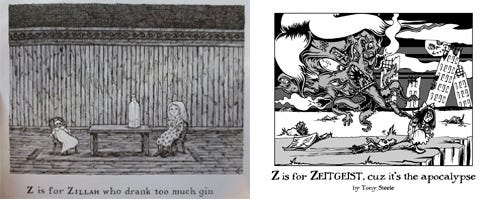
In 26 different images, the 2016 persiflage transposes the visual language of the original source directly onto a set of new images. While most of the illustrations in the amusing A-Z feature distorted drawings of Trump, it is the last picture that eventually sees him morph into a tentacled, bog-eyed and bewigged creature, wafting over a dystopian landscape and ushering the little girl Zeitgeist over a cliff. The Trump ABC is a reinterpretation directly addressing a range of policy issues that the illustrators see as marking out the Conservative candidate as unsuitable for the office of Commander in Chief. In doing so, it relies heavily on the retention of the original alphabet structure and uses textual elements to deliver its criticism.

Gashlycrumb

This first example shows the ways in which satire allow us to make sense of current issues through already familiar visual contexts. While stealing from or ‘being inspired’ by other art work is one of the most common ways for artists to find authentic expression for their own ideas, most monsterisation processes are a lot more complex than this. Often when a new monster is born, it dodges attempts to be assigned a conclusive meaning. This is not only because it draws its fangs and slimy limbs from a variety of visual sources, it also relies on the violent deformation of forms and contexts. Monsters leech off images that are freely circulating in popular culture. In their bellies they churn around these ideas and regurgitate them into new, puzzling and scary shapes.

When monsters fuse the remnants of several texts and images onto their bodies, it is not only incredibly difficult to make out the exact sources that have served as inspiration; exactly what they are saying, alluding to and achieving also becomes much more ambiguous.

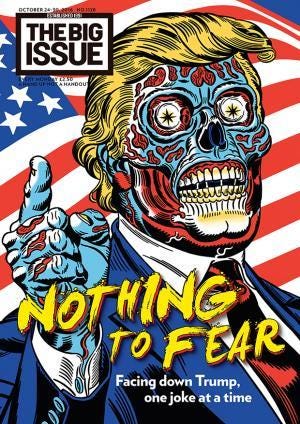
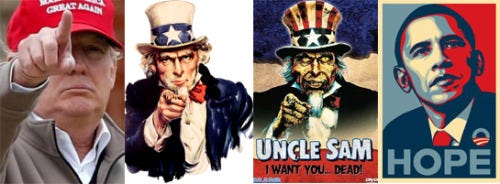
In October, a Big Issue magazine featured a cover illustration of Donald Trump in jarring colours reminiscent of the iconic ‘Uncle Sam’ image in which a man points at the onlooker. Big Issue, for those not familiar with the British publishing landscape, is a magazine set up as a social enterprise and which has been around since 1991. It prides itself on producing high-quality journalism and is published on behalf of homeless and vulnerably housed people who are able to support themselves through working as street vendors. The magazine covers are usually laid out in striking colours, sometimes featuring celebrities or allusions to current affairs. The picture on that particular issue is special because it is not merely an amusing picture of a person of current interest, but because Trump has been turned into a zombie-like creature. The aesthetics of the figure are directly informed by the John Carpenter alien invasion B-Movie They Live which was made in response to Reaganomics. In the film, a special pair of sunglasses allows the wearer to detect the weaknesses of the American democratic system as personified in fleshless aliens. Below I hint at the various visual and pop culture influences that have come together in this figure.

Donald Fear

The origin of Uncle Sam as the personification for the United States is apocryphal but likely dates back to at least 1812 when America was still, or yet again, at war with Britain. It took about a hundred years, until 1916, for the image we know now to solidify into its iconic state. The illustration by artist James Montgomery Flagg appeared first in the magazine Leslie’s Weekly under the title “What Are You Doing for Preparedness?” and later, in the Second World War, served as a military enrolment poster. The creature with its exposed jaw and teeth also has distinctly zombie-like features. The idea of Uncle Sam as a zombie is not new: in 1996 — a time in which the States were involved in numerous military operations all over the globe — a horror military comedy lured punters into the cinema with the catchy tagline “Uncle Sam wants you… dead!” Now, this unspecific personification of America’s national pride has been swapped for an actual politician.

This Trump Monster both invokes the uncertainty about America’s future and plays to the popular conceit of a dystopian apocalypse. The flesh is taken off its face, revealing the sinews underneath which are made up of the colours of the American flag. The ‘rotten core’ forms a visual antithesis to Obama’s iconic 2008 election poster in which the colours of the flag are unambiguous and blocky, an image surface on which ‘Hope’ is quite literally projected. In contrast, the projection of fear reflects back at us a jarring zombie-esque face, and instead of “Hope” an ironic “Nothing to fear” in a B-Movie alien flick font is splattered across as an ominous warning. The Trump alien erupts from the complex paradoxes that underlie American history exactly in that moment when the patriotic idea at the core of Uncle Sam is twisted into senseless oblivion by a demagogue.

Wants You

Another example draws heavily from European cultural history. Greek mythology, with its unreasonable deities and suffering demi-gods, has been a rich source for artist reworkings throughout the millennia. Cursed by the goddess Athena for ‘laying with’ Poseidon in a sacred temple, the snake-headed female Medusa has become a popular choice especially when attacking women in power.

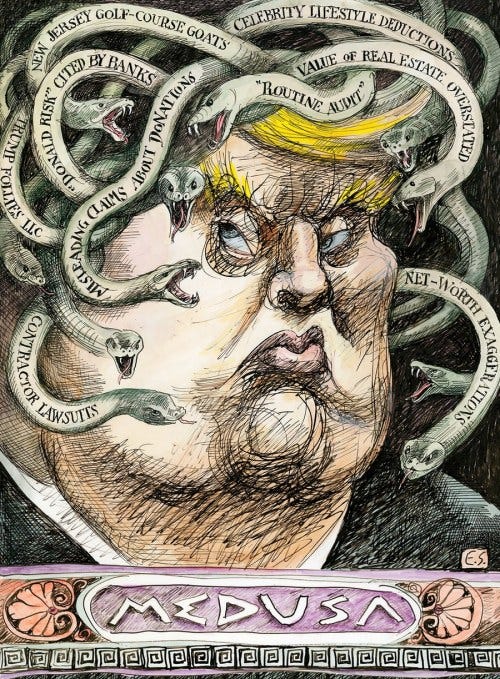
Donald Medusa

Vanity Fair’s illustration by Edward Sorel which depicts Trump as the ancient Gorgon beast appears a strange choice for a refiguration of Trump as monstrous. According to some interpretations of Ovid’s take on the story, Medusa was cursed by Athena after being raped by Poseidon. It introduces a strange irony into the picture to cast a man accused of, and bragging about, sexual assault in the role of a vilified woman. There is, after all, a history of female artists of reclaiming monstrous females, such as Medusa, to probe female relationships (Sylvia Plath, for example, wrote a poem about her mother which alludes to the myth).

The article accompanying the picture discusses the convoluted tax issues around Trump’s business empire. Therefore, the central themes of the underlying myth have been completely emptied out and have little bearing on this new monster. Instead, an amusing jibe about Trump’s unruly hair is fused with the symbolic character of the serpent standing in for regeneration. This aspect is perhaps more prominent in the myth of the many-headed snake creature Hydra which regrows a new snake head when one has been hacked off.

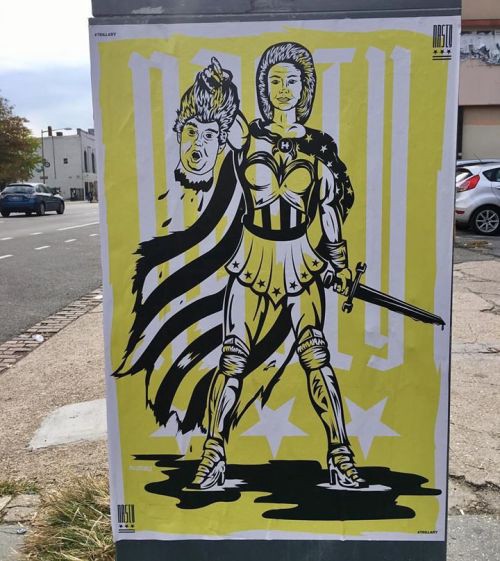
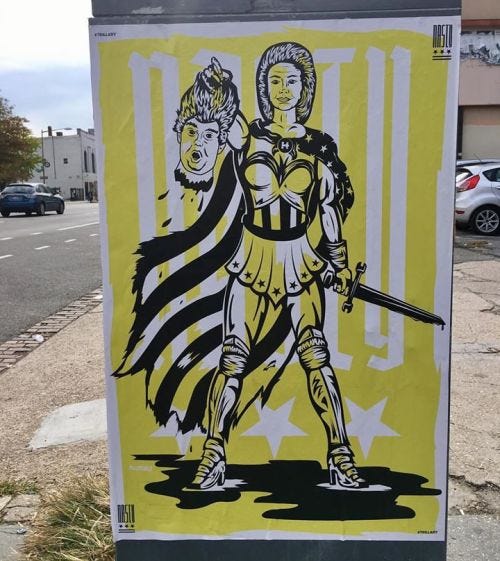
More intriguing in context with the same mythical background is this street poster which depicts Democratic nominee Clinton as a female Perseus slaying the Medusa. While the askew Medusa/Trump parallel is still present, the focus of the image is on Clinton dressed as the American comic book super hero Wonder Woman.

perseus

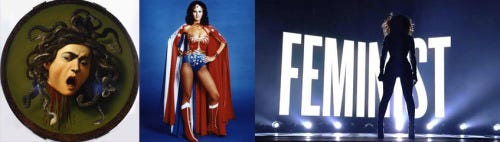
In the original myth, the alliance between the cursing goddess Athena and the conquering hero Perseus stands opposite the ‘perpetrator’ Medusa. The two women, according to art historian Marina Warner, act out the conflict between a woman being able to demonstrate masculine strength and her role as a fertile woman and victim (in her moment of death Medusa gives birth to the fantastic beast Chrysaor and the winged horse Pegasus). In the act of violence committed by the new Clinton-Perseus lingers the rejection of traditional binary gender circumscriptions that govern how are females in power are supposed to act.

feminist

The picture also alludes to the misogynistic attack that Trump has repeatedly launched at Clinton. On top of the figure the word ‘nasty’ is printed in a celebratory gesture of reclaiming a word that was meant as an insult. The way that figure and font are positioned in relation to one another echoes pop artist Beyoncé’s reclaiming of the word ‘feminist’ in one of her performances. Only in taking on the role as the Medusa slayer and exerting violence, the proto-masculine hero turns into an empowered female. For those who want to know more about the Medusa, Elizabeth Johnston has written a great article for The Atlantic examining how, throughout history, powerful women have been vilified through portraying them as the gorgon.

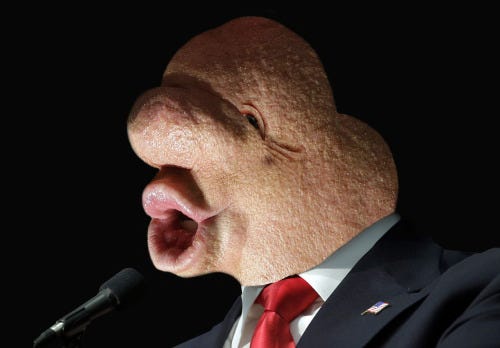
To finish off this menagerie of political monsters, I would like to share one of my favourite Trump monsterisations. It comes from a blog on tumblr that regularly posts stomach-churning photo manipulations using a different, uglifying strategy.

donald trumo

Instead of overlaying countless intertextual references, the artist reduces the facial features of Trump to only a few aspects (hair, chin, mouth) and distorts any human familiarity. It’s a literal defacement of the politician the artist would like to get rid of. This deformation transfixes the perceived human failure of the candidate on moral, ethical and behavioural levels onto the visual body of the new monster.

When new creatures come to life, an awareness for the visual strategies involved in their generation is vital in order to pin down the heavily politicised ideologies behind them. The kinds of monsters we encounter in popular culture are part of the currency of creatively facing contemporary challenges.

Sources:

The Ghastlycrumb Tinies: https://www.brainpickings.org/2011/01/19/edward-gorey-the-gashlycrumb-tinies/

The Ghastlytrump Tinies: http://ghastlytrump.com/

Big Issuehttp://www.bigissue.com/the-mix/latest-issue/7059/issue-1228

Vanity Fair article: http://www.vanityfair.com/news/2016/06/the-great-trump-tax-mysteries

Vogue endorsement: http://www.vogue.com/13492873/hillary-clinton-endorsement-president-united-states-democrat/

Medusa and women in power: http://www.theatlantic.com/entertainment/archive/2016/11/the-original-nasty-woman-of-classical-myth/506591/

Marina Warner, Monuments & Maidens, (London: Vintage 1996), pp. 113–114.

On Defacement: http://nagualli.blogspot.de/2013/03/michael-taussig-from-defacement-public.html

Dinild Trimp http://dinild.tumblr.com/


Originally published on icollectmonsters.tumblr.com

Republished on the Monster Network.

Shadows Schaubühne Berlin

Eurydice (Jule Böwe) would prefer to stay in Hades instead of returning to her husband Orpheus (Renato Schuch), a wannabe-Morrissey who desperately needs her back to boast his own ego.

With Schatten (Eurydike sagt) – Shadow (Eurydice Speaks) – Nobel Prize-winner Elfriede Jelinek continues to twist the cultural canon to tease out the misogyny that nestles all too comfortably in the stories we tell about tragic heroes and beautiful female trophies.

At Berlin’s Schaubühne Katie Mitchell directs this Greek myth as a slick road movie, complete with a revolving VW Beetle and zombie-eyed ferryman (Maik Solbach). After Mitchell’s recent foray into short films, working with writer Duncan MacMillan and cinematographer Chloe Thomson, she has enlisted Thomson to help create this ever-shifting film set for the stage.

In 2015’s Ophelias Zimmer, her previous collaboration with writer Alice Birch, Mitchell’s ‘live-cinema’ camera aesthetic refocused the story of a sidelined female character through a feminist lens. The aesthetics of Shadows obscure more than they reveal, however, and the production consequently lacks charm. It feels at times like the taping of a particularly ponderous TV drama.

Mitchell, in collaboration with Birch and dramaturg Nils Haarmann, sculpts a surprisingly literal narrative from the original swamp of a text. And while it is intriguing to watch how the shifting corridors and tunnels of Alex Eales’ netherworldly set add uncanny depth to that journey, it means that Böwe’s world-weary Eurydice remains trapped in a production that leaves the audience oddly untouched.

Originally published in The Stage.