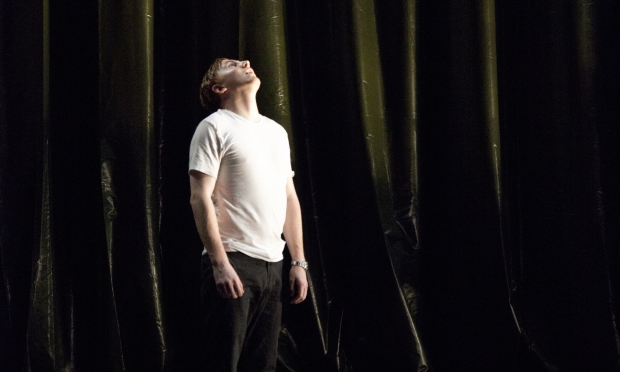
Clipping the Right Wing Theatre Uncut at the Pleasance Theatre

Seven writers and one question: “Do we all get more right wing in times of austerity?” Theatre Uncut, this year in its second new writing season, presents short plays by writers from different countries and makes them available to young theatre companies. BAREtruth Theatre accepted the challenge and dishes up a healthy portion of activism. At the Pleasance Theatre.

Neil Labute’s Pick One opens this evening of rehearsed readings with a play that’s as bold as it is simple. Using the conceit of a private “blue sky thinking” meeting it has its three characters talk themselves into believing that genocide is a sensible approach to solving and preventing austerity measures. Exposing some of the simplistic argument structures of conservative reasoning the play is even more sobering because of its dry humour and the fact that these characters seem so much like the kind people that really sit in the important chairs in our governments and multinationals.

Although it remained the strongest of the pieces the rest do not fail in bringing some relevant points about the disconcerting attraction right wing argument seems to have in times of austerity into view. This is made clear most plainly in Clara Brennan’s The Wing. A conflicted father-daughter relationship is used to examine the rising popularity of the English Defence League in recent years. The piece turns into a bit of a rambling, activist rant ultimately illustrating the helplessness of the two sides in making their convictions understood to each other. The other pieces fall between the two extremes of witty satire and heavy-handed outrage.

Capitalism In Crisis by Tim Price is a story of how money can corrupt even those with the most idealistic mind set. The simply structured piece centres around two characters that get involved in the Occupy movement. Although it’s lacking some of the necessary punch there definitely is some measure in the thoughtful pace and deliberate symmetry. Structurally less successful is Kieran Hurley’s piece Amanda about a stressed MP taking a bath and the three narrator voices in her head talking about her struggles and failings.

True or False by Davey Anderson is by far the most ambitious of the short plays. A story about what appears to be an undercover agent infiltrating rebellious youth and instigating violence against authorities, the piece has some surprising twists and turns which make it a bit sprawling. It’s full of originality, which is more than can be said of the rather disappointing Project NIGHT by Tanika Gupta.

Church Forced To Put Up Gates After Font Is Used As A Wash Basin By Migrants by Mark Thomas about a newspaper proprietor does not only have the best title of the lot but handles its material with panache and some great one-liners. It’s always entertaining to put one over on a newspaper that spews hateful stories against the negative impact of immigrants on British tax payers and that itself has more than questionable tax arrangements.

Melissa Dean’s direction is sometimes slightly unfocussed especially when the text itself is a bit messy like with True or False but considering the whole evening is designed as a rehearsed reading the whole company manages to develop the structures between the characters very well. And bravo to sound engineer John Clark for sneaking in some Lou Reed at the appropriate moment. An evening which successfully gives short shrift to too complacent leftist sentiments and aims to highlight the absurdity and dangers of conservative political lingo.
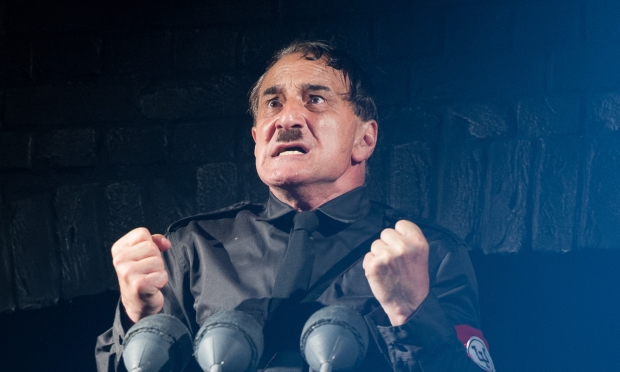
Terrifyingly funny cauliflowers: The Resistible Rise of Arturo Ui at the Duchess Theatre

The Resistible Rise of Arthur Ui is a thinly veiled parable giving account of all the key events in Hitler’s rise to power in the 30s in Germany. This stylish production set in Chicago’s gangster world during the heydays of the Great Depression features a strong cast. It’s so funny, it’s terrifying. At the Duchess Theatre.

Unoriginal and didactic, Brecht has been called many things in his lifetime, but one can’t deny the fact that he had a razor-sharp mind that was able to cut right to the bone of political atrocities. Recreating the world in a theatre can only make an impact if what is described can be conceived of as changeable. And when we watch the ridiculous imp Arturo Ui weaselling his way up through a reign of violence and manipulation, Brecht shows how he thinks Hitler could have been stopped. Although Brecht refused to call this play a parable, it is exactly that. All of the events in the play correspond to real events in the 30s and 40s in Germany, and we see how Hitler climbed up the ranks in the government to become chancellor of the Third Reich.

The play’s setup adds a comedic spin as a means of estranging the viewer. Instead of government politics, we deal with shady vegetable business men. When the cauliflower trust in Chicago suffers economical pressure, they need someone to get their business going again. Enter Arturo Ui and his muscle Ernesto Roma (Michael Feast), who are keen to rise up from petty criminals to rub shoulders with the influential men of the city. William Gaunt’s Dogsborough, like his real life equivalent Reichs president Paul von Hindenburg, is a resigned man lured into corruption by the promise of money and power.

From lush costumes, effective lighting and atmospheric set – this production is slick throughout. This visual feast is welcome, as the show has quite a slow start and exposition and character introductions take up a while. The language (in a gorgeous translation by George Tabori) is melodious, sometimes lulling, and the text is often relentless and refuses to simplify the matter. Luckily, everyone is in for a terrifying payoff. The more you know about German history from that time, the better this payoff will be.

Ripe with references to Hamlet, Richard III and Macbeth, the play exposes how political power and performance always go hand in hand. Political narratives are made by people, and it’s the responsibility of theatre makers to smash these narratives, to pick them apart and expose their artificiality if they are harmful. This comes together best in the flower shop, which uses Goethe’s famous Faust scene to explain the annexation of Austria to Germany. Here Ui woes his Gretchen Betty Dullfoot while David Sturzaker’s disconcertingly chirpy Givola distracts her husband. Lizzy McInnery plays the brittle Lady Anne-like character as a great foil to Henry Goodman’s smarmy Ui.

Goodman’s scene with Keith Baxter’s Shakespearean actor is a highlight of the show. When Ui decides to improve his public performance they stumble through the famous Julius Caesar speech “Friends, Romans, countrymen” and the audience rejoices in watching this buffoon (and the terrific clown Goodman).

The conclusion of play was probably the single most terrifying ten minutes I’ve ever spent in a theatre. I assume that it was not simply my German guilt, but when Ui stands on a high, red platform passionately talking about expanding the vegetable business, I am watching through tears while Brecht’s texts forces me to laugh. It’s a cruel experience and is owed to Jonathan Church’s clever direction as well as Brecht’s thieving, didactic genius.

Glittery, hot mess: The Lightning Child at Shakespeare’s Globe

With their latest Season of Plenty offering the Globe invites to a trippy celebration of the Dionysian spirit. In The Lightning Child Ché Walker and Arthur Darvill have reworked Euripides’ The Bacchus into a sprawling joyride spiced with musical numbers. At Shakespeare’s Globe.

Everything starts out so promisingly. The colourful Globe stage is draped completely in white. A white orb looming over the stage and Neil Armstrong and his wife argue about whether man should walk on the moon. They talk about man’s limitations and aspirations and Neil has got a proper space suit and everything. It’s beautifully surreal in its simplicity. When he’s finally up there Neil finds out that there is already a man/woman on the moon and a long, sustained “What just happened?” moment later the 2001: Space Odyssey look has given way to a colourful, glittering Disco, complete with dancers in golden leotards. The Jack Sparrow look-a-like ladyboy herald (Jonathan Chambers) will act as an MC and does his best to guide the audience through the somewhat patchy story.

Dionysus, son of Zeus, and his tribe of nymphish worshippers enter the city of Thebes, and with him comes a wave of debauchery that Pentheus, the ruler of Thebes, cannot tolerate. No music or dance is to be permitted and certainly no worshipping and crossdressing gender-bending self-fulfilment. Dionysus plans to take revenge on Pentheus who, he feels, denies him his rightful god status. There are lots of spells, disguises, and people getting turned into snakes – it all sounds like a pretty straightforward Greek tragedy to me. In Ché Walker’s and Arthur Darvill’s hands, however, the tragedy turns into a hot, glittery mess, and that is not always as exciting as it sounds. If unfamiliar with Euripides’ play, you might get a bit a lost as Dionysus prances around the stage like the Willy Wonka of wine and rhythmically trash-talks the militant Pentheus. Tommy Coleman gives a strong performance full of charisma as Dionysus, the smooth, ensnaring half-god.

The traditional myth is intercut with at least four more modern plays-in-a-play that illustrate how Bacchus’ spirit still impacts us today. In some way or another these stories are concerned with the different ways in which humans go to extremes or to which extended excellence impacts human relationships. A particularly well-exercised vignette, however, deals with a different side of obsessive behaviours, which has Globe regular Phil Cumbus and Harry Hepple pining away as hopeless heroin addicts.

Even though actor, drag queen and activist Bette Bourne gets to go down a somewhat unneccesarily sweary route in his portrayal of Teiresias, generally the writers’ joyous handle on language is fresh and entertaining. When the play time travels to a dressing room in 1959 in which Billie Holiday and Lester Young discuss their shared understanding of the universal world pain, we see the potential and problem of The Lightning Child wrapped into one. These two jazz idols and their harrowing demise stand in for one of the main motives of the piece: artistic excellence and the experience of pain are two sides of the same coin. Alas, the way this is wedged into the play does not create a poignant coda to the main story, but a confusing digression that loses most of the audience along the way. And sadly, the attempt to connect the importance of gender transgression in a meaningful way to the other parts of the play feels slightly awkward and forced.

So, structurally a bit of Aristotelian moderation would not have gone amiss in this three hour ride. When one of the characters says that “mortals need to accept their own limits”, we wish that the creators had embraced the limits a bit more to allow the Dionysian spirit to shine through clearly. Violence and ecstasy spike to unexpected heights in this celebration of all the contradictions of life. As quirky and unconventional adaptations go, this one is an absurd and flawed monster of a play that constantly swings between clever entertainment and self-indulgence.

Missing the forest for the peas: Secret Theatre Show 1 at the Lyric Hammersmith

In Sean Holmes’ speech a few months back the Lyric’s artistic director sharply diagnosed that theatre in this country has succumbed to a corrupting reign of commercial interests over artistic merit. Holmes announced his attempt at fixing a corrupting system. The result is a season of up to seven shows the title of which would not be revealed in advance. At the Lyric Hammersmith.

As a theatre-maker, the transition from a German rehearsal room to a British one can be quite a culture shock. Here, chances are that, as an actor, if you want to discuss a character’s motivation you will be told in no uncertain terms by the director to stand where he tells you to and say your lines. It shouldn’t be like that, but I’ve seen it happen.

This segmentation of a wholesome creative process extends to all parts of the production process, and as someone who comes from a strong (European) dramaturgical tradition, it still is highly bewildering to me. This is why when I read Holmes’ speech it was as if someone finally saw what was wrong in the over-saturated British theatre industry. In its worst manifestations, it treats its actors like cattle and its audience like crop that only needs to be harvested, and here was someone set on doing away with the dictator-directors and literal bores and bring back the playing and questioning.

Things Sean Holmes forgot to mention about central European theatre is that more often than not it’s hopelessly hierarchic, and its mistress might not be commercial success but a self-imposed debt to tradition with an annoying compulsion to shock audiences. Even the small city theatres (at least in Germany) seem to suffer from some kind of Faust or Georg Büchner OCD.

So what I expected to come of this experiment is a piece of theatre full of artistically uncorrupted vision, an idealistic union of the the merits of both systems that enables creatives to discard all of the structurally rotten aspects.

How disappointing then what really is presented on stage is a muddled and unengaging rehash of an overdone play which has been done sharper and more acutely before. Whereas the OneStopArts editor was annoyed by Show 2, I was merely disappointed which, in a way, is even worse, because I want Holmes’ project to succeed so very much.

The marketing ploy of secrecy (that created a bit of a storm in a teacup when one critic revealed the title in the interval of the press night) hardly amounted to more than a nice anticipatory buzz ten minutes before the show and lasted until about three minutes into it. Before the first words were uttered I knew what the piece was going to be. And from then on the thrill of secrecy crumbled away along with every unrealised potential of this project.

The tale is of penniless soldier Franz (Billy Seymour), who commits himself to questionable medical tests to earn a bit of money on the side for his family. His scrupulous doctor (Steven Webb) gets overexcited when Franz has delusional periods because of a forced pea diet and his wife Marie (Katherine Pearce), who is fascinated by the military glitz and allures of the drum major (Charlotte Josephine), all contribute to Franz turning into a mentally unstable person. The piece could raise all sorts of fundamental issues about privilege, jealousy, exploitation of the working class, moral and virtue.

There is a moment in which the cast gives us a beautiful canon rendition of “Der Jäger aus der Kurpfalz”, a traditional German folklore song which originally had strong sexual connotations. It illustrates how the ensemble’s relationship with the text is deliciously layered. This is theatre that demands so much from the audience, yet gives back so little entertainment and viewing pleasure. I don’t think that the creative team will count this as a negative criticism but that’s how it’s meant.

Considering that the show clocks in at just 75 minutes it’s astonishing how much uninvolving ennui there is. While there were some very good performances, I did not particularly feel that the ensemble inhabited the characters better because of their special work process – a big issue if that is one of your selling points for the season.

So why has this shot at a theatrical utopia not quite worked out? For one, it’s just a bit lazy to draft up an artist manifesto that claims that failure is as instructive as success. What do these concepts even mean in an experiment that tries to cut itself loose from the dictate of commercial success?

And even more importantly: nothing is truly that different. The creative vision that we have been promised turns out to be a resolute refusal to narratively ease the audience into the fragmented scenes of the original. I truly admire that Holmes has made room for methodological ruthlessness in the rehearsal room. The stark aesthetic approach and the unresolved roughness of this production pays tribute to this process of working towards a greater understanding of the material. Crucially, however, the production fails to extend the depth of this understanding to their audience. Part conscious alienation, partly a punchless meandering around the original fragmented material, this production has not left its draft state. Some will find this exciting, and some simply won’t.

Having said all of this, the first two secret theatre shows may not have wowed, but let’s not give up yet on a more idealistic approach to creating theatre on a commercially relevant level. For the rest of the coming season I’m hoping for more new writing, more viewing pleasure and, in the spirit of finding back to “playing”, maybe even a little less self-important earnestness on everyone’s part (that, by the way, includes us critics too).

Review originally published on OneStopArts Theatre.