Doctor Faustus at the Rose Bankside

420 years after its first performance, Christopher Marlowe’s Doctor Faustus returns to The Rose Playhouse, Bankside. In this version the original text has been cut down to an 80-minute one-man piece. It’s a bold move that unfortunately doesn’t pay off.

At the core of what has made Doctor Faustus a universal play and often quoted literary motive for well over 400 years, is man’s fascination of reaching beyond what is known and what he is ready to sacrifice for that. It’s nothing less than the progress of society that depends on the very urge to move the boundaries of knowledge forward. A new approach to a classic text, which gives us a different angle on the brooding Faustian hero is therefore always welcome. The fabric of the narrative is well known: German scholar Faust dons the robes of common scholarly disciplines and shrouds himself into the dangerous cloak of dark magic.

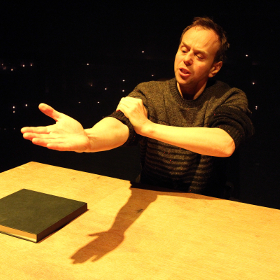
An empty chamber, a chair and a desk with four books – it’s a plain setting for the infamous pact with the devil, which turns out to be a disappointingly anaemic affair.

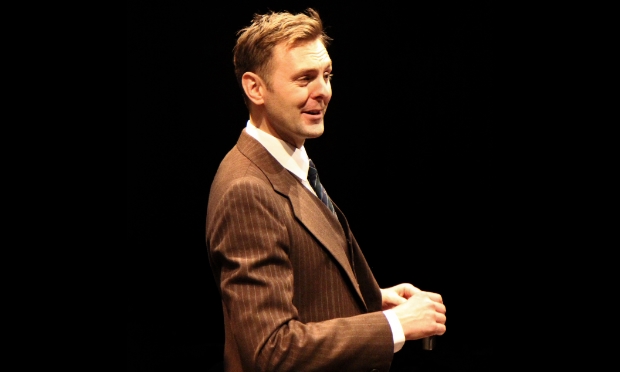
Christopher Staines gives a committed performance as Faustus but he does not quite create the necessary magic pull to hold the audience’s attention for the entirety of the piece. It all hangs together somehow but only by a thread, and instead of going from soaring height to height, the piece moves somewhat sluggishly from well-known quotes and even better known soliloquies. Devils, dragons, magic tricks – that’s what Marlowe’s existentialist romp is known for. If the spectacular is removed from the piece it should be replaced by something very substantial and fundamental. It hasn’t been, and that’s the crux; and it so happens that the audience arrives at the famous Helen of Troy speech without really having made the emotional journey to appreciate the melancholic yearning of a man filled with regret who is yet unable to repent.

A stark deviation from the original text set in the Vatican shakes the whole piece up a bit. In an improvisation sequence Staines degenerates into a childlike state and speaks in funny voices with little torn-out-bible-pages paper men. The sight of a man who was out to examine the fabric of space, human nature and knowledge and ends up mistaking practical jokes for power needs to be more tragic than what’s offered here by Staines and Parr.

Or is the actor in the end just a mad man in a cell? Is the voice of the devilish henchman Mephistopheles just in his head? If this was a proposed reading the directorial pushes were maybe too weak to create a gripping conceptual angle. It’s stripped too bare to be visually engaging; even the setting of the Rose excavation site in the background dotted with hundreds of candles doesn’t change that.

While his last year’s Hamlet was a bravely cut version that zipped along rather nicely, this new offering from director Martin Parr lacks a distinct narrative purpose. One can’t help but think that the commemoration of Marlowe’s 450th birthday would have deserved a more captivating version.

Please note: The reviewer saw the preview on the day before the show opened.

Sugarplum doggy: Dog’s Don’t Do Ballet at the Little Angel Theatre

A playful adaption of Anna Kemp’s 2010 children’s book of the same name, the puppetry piece Dogs Don’t Do Ballet had a sell out run last year. With its unbounded playfulness it’s not hard to see why. At the Little Angel Theatre.

Biff is just as passionate about dance as his owner, Anna. And, although he appears to be the unlikeliest creature to do ballet, he won’t be stopped. He follows Anna to her lessons and tries to convince the nay-saying father to let him go to see a show with a star ballerina. Of course he refuses! But there are others too who stand in his way: Anna’s ballet teacher, Miss Polly, also thinks that dogs don’t belong on the dance floor. His growing resentment culminates in a nightmare sequence in which he is haunted by oversized red ballet shoes (don’t worry, it’s not too scary but rather beautifully done). But Biff is cannot be deterred; he wants to wear the tutu and he will dance.

Dog’s Don’t Do Ballet tells the powerful and simple story of how a little cheekiness and determination can go a long way in achieving your dreams. The message is universal, and the show manages to be so much more than a children’s show; there’s food for thought for adults here, too. If a dog can do ballet then you can get that job you’re aiming for or do the marathon you’ve always been dreaming of running – you just have to set your mind to it. There are some loveable characters in the piece too, such as the extrovert Miss Polly (Ronnie Le Drew) who struggles to give commands to her easily distracted assistant Marjorie. Le Drew and Andrea Sadler are subtly brilliant as puppeteers and breathtakingly funny as the various characters.

The props and puppets have a comforting, old-fashioned, crayon-like look. Keith Frederick’s design here has none of that jarring and loud visual style modern children’s entertainment seems to have subscribed to and, together with the story, is captivating enough to sustain the children’s attention. The dramaturgical approach to the stage space is fairly free which enables the performers to use puppets of different sizes in a fluid way to move the story along.

Like so many of the scenes the final showdown in the Royal Ballet is tender and uproariously funny all at once. Think prima ballerina, sneezing and a tuba. This show is delightfully innocent entertainment with poignant messages and a feel good factor. And on top of all that, offers a playful introduction into classical music for the little ones. The piece playfully incorporates works from Delibes to Tchaikovsky as well as an entertaining tour of the main instruments of an orchestra. A precise and well realised play that looks completely effortless and fun. A must see for under six-year-olds and a should-see for everyone else.

Bonny but not blithe: Much Ado About Nothing (for Christmas!) at the Park Theatre

Slightly unremarkable is probably the most fitting way to describe ACS Random’s production of this much loved Shakespeare play. The intriguing idea of setting the piece in a 1940s post-war setting is sunk by unnecessary sincerity and not enough sparkiness. At the Park Theatre.

Newsflash: The war is over, the enemy defeated and the boys are back. It’s Christmas and the Mediterranean Messina is swapped for a British upper-class mansion. The returning soldiers find themselves in Leonato’s home where Beatrice and her cousin Hero greet them. It doesn’t take long for Beatrice to pick a fight with Benedick, an old flame and sworn bachelor. There’s still a spark there when the two of them engage in some verbal duelling, but alas – in this production – it’s not quite right. Garry Summer’s fidgety Benedick is not cocky enough to keep up with feisty Beatrice. Lines that need to stab merely poke and twists that need to surprise only arouse mild interest. Libby Evans’ Beatrice is full of panache and intent but without the right chemistry between the central couple the balance of the play is in danger.

It wouldn’t be too bad if the rest worked but there are just one too many misjudged directorial choices in the piece. Scarlett Clifford plays Hero as verdant debutante with a crush on the young Claudio (Andrew Venning). To have her constantly giggle like a schoolgirl makes the character appear a bit vaporous but in a production of Much Ado it’s always a challenge to make any Hero anything less than a bit of a drag because she’s such a passive character and a play-thing for men’s whims. And it’s true that we do feel for her when she is shamed and breaks down, with only Beatrice rooting for her.

The juicy villain is quickly found in Don John who here is presented as a repressed homosexual and Jack Lewis’ interpretation works well within the setting. To clear away the villainous mess Gordon Rideout and Catherine Nix-Collins are brilliant as the gormless guards Dogberry and Verges tapping into the richness and the humour of the malapropisms. The two might possibly be the best thing about the whole show. Unfortunately when they come to meet with Julian Bird’s starched Leonato, the fun stops.

The overbearing sincerity of long stretches of the production obfuscate moments of real emotional punch. Sometimes the stiff upper lip tone of the chosen setting jars with the dramatic high points. When Claudio shames Hero and consequently Leonato condemns his daughter while she is at his feet sobbing one can’t help but want to tell them to pull themselves together and have a cup of tea to calm their nerves. It’s all a bit like Woodhouse without the wit. Some awkward blocking and laboured motivations for action do the rest.

Zarah Mansouri’s set design is sparse but fittingly so reflecting the post-war austerity of the setting. There is, however, a defiant glamour in the Christmassy hue that’s spread over the production including the rather elegant and gorgeous costume choices, even if the choice of Christmas as a time setting is purely decorative.

This production somehow manages to highlight the weak spots of the original while spoiling its own idea. Although there is a wonderful mime-only scene that provides some Benedick and Beatrice backstory I’m certain that the story would have been somewhat confusing for someone who has never seen the play done before.

Jumpers for Goalposts at the Bush Theatre

Tom Wells (author of the acclaimed The Kitchen Sink) creates a poignant and funny story about dealing with grief, gay life and having the balls to overcome adversity. Produced by Plaines Plough, Hull Truck and Watford Palace Theatre, Jumpers For Goalposts is somewhere between Gregory’s Girl and Bend It Like Beckham. At the Bush Theatre.

Viv is angry and Joe is sad. Danny likes Luke and Geoff needs to find his song. An ingeniously simple six-scene structure takes us through the season of an LGBT five-a-side football league. We root for Barely Athletic, a club set up by the somewhat stroppy lesbian Viv, played with a mix of aggression and sadness by the brilliantly scenery-chewing Vivienne Gibbs. Having been kicked out of the Lesbian Rovers, she assembles a team to help her win a coveted trophy.

Her brother-in-law and the token straight of the team Joe (Matt Sutton) is literally an everyday Joe, slightly flabby and out-of-shape. Both are united in their grief about Joe’s recently deceased wife. They are joined by Andy Rush’s cheeky Geoff – a devil-may-care sort of guy who’s always quick with a quip but after a vicious attack that left him physically scarred is haunted by some demons of his own. He’s trying to find a song to sing at Gay Pride but he needs to suss out some things beforehand.

At the centre of the play is the love story between assistant coach Danny (Jamie Samuel) and the new arrival Luke. When it comes to matters of football or love Danny’s self-confidence is somewhat hampered. Although smitten by the innocent, awkward but good-hearted Luke (an amusing and touching performance from Philip Duguid-McQuillan), he needs to come to terms with some uncomfortable responsibilities. The cast are all completely at home with the rhythm of the Northern dialect which gives the strong ensemble performance a rough charm.

Designer Lucy Osborne brings just the right kind of greyness to the set: a changing room that reeks of functionality, sweat and abandoned dreams. Although we never actually leave this room it is due to James Grieve’s unfussy and to the point direction that the tension never drops.

Unvoiced anger and fear are at the heart of a lot of the struggles. The players’ performance at weekly matches is closely connected to how they are coping with their personal problems. The weighty issues in the story are handled with surprising levity and situation comedy. So these sad clowns play, argue, win, lose and over time somewhat unwittingly help each other find their ways. None of the sentiments and ideas presented are necessarily new: team spirit helps overcome adversity; winning’s not all that counts; true love conquers old demons.

Luckily, the pairing of real topical issues with a sense of innocence and genuine love for its characters steer the production clear of any triteness or over-simplification. Tom Wells’ writing brings an affirmative spin to the way modern gay life in the UK is portrayed. Apparently, life is a lot like football. You tackle your problems, block your fears, and score points when you get the chance. When you think about it for a minute it becomes a lot less trite than it sounds.