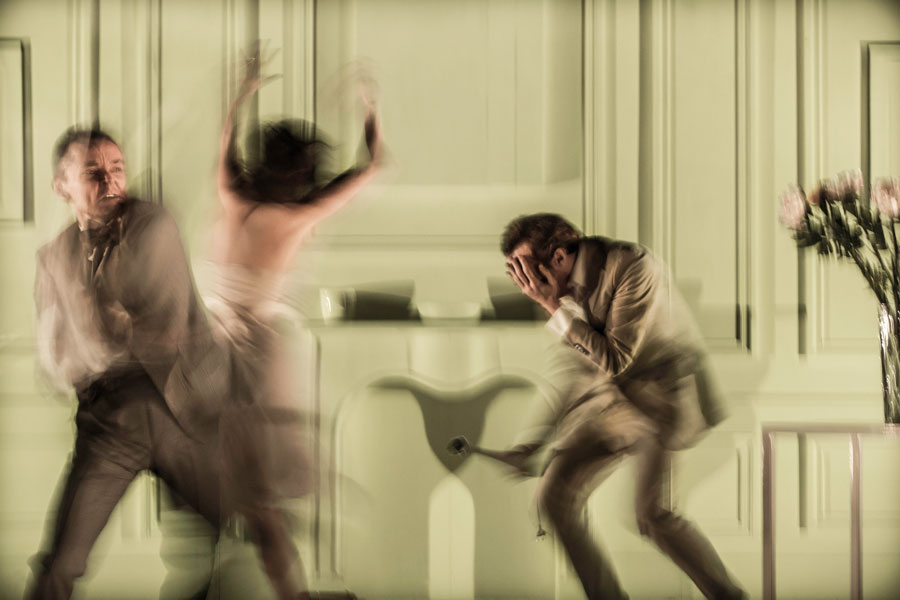
In Lambeth at the Southwark Playhouse

A sprawling tree like a cradle, a serene haven for suburban Adam and Eve: Catherine and William Blake. When a visitor intrudes, Paradise is Lost in more than one way. The tree leaves are dead and the crowd outside of this South London Eden is roaring. Revolutions, counter revolutions – killing in the name of freedom and human rights and wars to make peace or to free the oppressed. We’re in the Long Eighteenth century and in France, Britain, America – everywhere, really, unquenchable forces are uprooting the old order.

Jack Shepherd’s 1989 play is a fictionalised account of an encounter between Blake, a poet who converses with angels, his wife and Thomas Paine, the political commentator who stirred up the war for independence in America; the conservative meets the republican. Paine is not invited, trails a flock of angry anti-revolution protesters behind him and he also brings some meaty issues to discuss along with him. What good does art do in times of conflict? Is it the moral obligation of the artist to intervene or should he merely observe? Is change of corrupted power always a change for the best? Is it important to carefully ask questions or do you find answers to problems through action?

Tom Mothersdale’s Blake is a bemused and innocent sort of fellow, displaying the odd bout of childlike wonderment and eagerness when playing with his new toy in form of a late 18th century intercontinental revolutionist. Christopher Hunter delivers a forceful foil, playing Paine at first sermonising and later more enraged and provocative. Once warmed up, the belief systems of their characters clash rather beautifully. Paine believes that injustices like child labour and illiteracy need to be fixed in whatever way necessary even if it means overthrowing ruling class. Blake argues that violence must inevitably breed more violence. He argues that there needs to be some sort of revelation before sending people into their deaths for a hazy utopia that has never been created in thought.

Blake and Paine struggle to find a common language to negotiate their seemingly irreconcilable ideas about social change. Their anchor in reality is Blake’s wife, played by Melody Grove who keeps the difficult balance between admiration and bewilderment for these men full of abstract ideas. An unequal woman among men discussing equality. While the men drink and talk themselves into a rage, she is the one who interacts with the people on the streets. She sends the menacing protesters circling the Blake property on their way and protects the Paine from the lynch mob. The naturalistic staging and open performances create a sense of listening in to a dinner table discussion which fails to maintain the same level of engagement throughout.

The immediacy of the revolution around doesn’t quite make it into the garden (Ruth Sutcliffe’s divine design). Even the regular reminder that this is a local story taking place not far from Blake’s residence doesn’t change that. Maybe some of the audio effects are too incongruent to create a sense of danger. Maybe there is not enough externalisation of thought. Either way, Michael Kingsbury’s interpretation of In Lambeth leaves Eden intact. It is not crying bloody murder or even shouting out loud that we desperately need art to examine processes of social change. It remains a tame play of ideas which is a right shame given the explosive power of these ideas today.

Originally written for Exeunt.
RIFT’s Macbeth at Balfron Tower

Welcome to Borduria, the country inhabiting all fictional characters. Goldilocks lives in Northern Borduria but the portal in a basement of the brutalist Balfron tower in East London leads straight to the grim South where the unscrupulous and scheming Macbeths reside. Alongside these fictional characters live the Bordurian citizens who show the spatially shifted visitors around and speak in borderline offensive Russian accents.

Director Felix Mortimer said that he never calls his work “immersive” and it crucially isn’t. Ushered around by two chaperons with varying degrees of improvisational ability the audience experiences the story of the murderous couple in short bursts. Several flats on various floors of the building serve as sets for the banquet, murders, fights and plotting. Michael Adams and Sarah Ratheram were the Macbeths on this particular evening and so close up they were particularly captivating. Still, there is something inherently problematic with the way audience and performers interact and how the narrative is driven between the scenes. Clearly separated from the action I was mostly an onlooker but not always, there was a palpable awkwardness about what my role as an audience member was at any given point. Am I supposed to interrupt when someone is being murdered or would that screw up a perfectly planned time table? Gavin Duff’s Banquo and Roseanne Lynch as Lady MacDuff manage to blur the line as their performance aura is more penetrable and their fate so bloody that compassion and shock gets rid of all dramaturgical concern.

Alexander Luttley’s flirtatious Porter gives us a rare interaction with a fictional character and there is an utterly creepy devised scene by Gruff theatre which should not be spoiled but it feels like it’s straight out of a horror film. However, it’s all too brief and doesn’t entirely slot into the rest of the evening. Exploring and roaming is not encouraged and questions to where certain doors lead are blocked rather unceremoniously. I remain contained in the space and controlled in my actions to the point of frustration. After I was placed in front of a telly blaring out lengthy faux news material in a moment of unchaperoned free will I decided on a visit to the loo. It turns out to be bad timing indeed and I missed the tragic Lady Macbeth scene. Tuts and disapproval from the chaperons greet me and I feel guilty for what is essentially a structural weakness of the piece. On every staircase or behind every corner there are Bordurian stage managers and assistants with clipboards not so secretly directing groups of actors from one place to the next. What a logistical effort from cast and crew, sadly not one that convinces entirely. The borscht served at dinner was terrific though, it was blood red and therefore matched the plan of the murderous couple perfectly.

A note on details in world building: the passport necessary to enter Borduria and which is never referred back to throughout the performance strictly states potassium – or Banana – consumption is not advisable when traveling through the rift, yet the trifle served at dinner contains bananas. Little details like that show that this mammoth project is ultimately a fractured project and instead of emanating new insight these fractures unveil the crumbling substance of the piece itself. The Bordurian substance then, a mostly consistent design reminiscent of the socialist GDR in the 70s, falters behind the drab facades and curtains.

It all has to do with expectations, really. Having experienced the meticulous location detail and research that went into other promenade shows (think Punchdrunk or Signa) this one disappoints. However, it has to be acknowledged that with its aim to be more than just a variation on a theme and actually follows the plot of the play the production has set itself a difficult task.

The tagline of the performance is “Does murder sleep?” and the answer to that is “Yes, very well, thank you.” Why I was made to stay overnight remains a mystery as the main action is all wrapped up by 1 am, no murderous shouts or midnight wandering. I suppose, there’s nothing like being woken up after five hours of sleep, made to climb up seven flights of stairs to stand on a wet East London roof top to witness the fizzled out after pains of a promenade performance. Astonishing clear view over London with a cup of coffee and Bordurian ramblings around me – odd, but definitely an experience. Clearer than anything else in this show is the potential of what could have been.

The Crucible at the Old Vic

Mysterious and shrouded in fog, a group of women perform a solemn death dance around empty chairs – an eerie foresight into the fate of a community that will be decimated by a relentless witch hunt. As an opening it’s tender, quiet and simple, but also quite unlike the high-octane shout matches that dominate the majority of The Old Vic’s new version of The Crucible starring Richard Armitage.

Armitage who plays the adulterous farmer John Proctor scowls attractively from the poster outside the theatre and beckons to enter the world of 1692 Salem. Here, a group of young girls on the cusp to womanhood is discovered dancing naked in the woods. It’s an act of secret rebellion against the restrictive values of their Puritan community and it is quickly decided that this kind of liberation must be quenched. In the hands of the South African female director Yaël Farber The Crucible’s inherent misogyny shines through rather clearly but remains uncommented.

Abigail Williams, played by a fierce and nuanced Samantha Colley, is the leader of the group of young woman who starts accusing other community members of being in coalition with Satan. In swoop an examining reverend and a judge and the literal witch hunt is in full force. Personal, moral responsibility over your own actions is put up against unquestioned and perverted Christian values. While this gives an intriguing underlying conflict it is unclear where Farber sees her own emphasis. The overlong production (3h45 on the press night) seems to have been barely cut and as it is, its main focus is the hysterical way public debate is led if conservative values and moral ambiguities clash.

Soutra Gilmour’s design sees the Old Vic turned into an in the round space in which the audience is part spectator of the trials and part thrown into a crucible of heightened emotions itself. The dull colours of set and costumes drape a sorrowful cloak around everyone, giving a real impression of the hardship of 17th century life in the colonies. Prosecutor Govenor Danforth is played by Jack Ellis rather big-gestured as a stubborn and calculating official with little capacity for common sense. He doesn’t quite integrate into the whole lugubrious affair and when Armitage and Ellis have their exchange over Proctor’s confession it is an enduring shouting match that undercuts the poignancy of the “name” speech and lessens the impact of Miller’s beautiful use of language.

One of the plays difficult turns is that it morally redeems a man who betrays his wife with their teenage servant Abigail Williams and makes the girl out to be the aggressor. She is the real cause of all the evil befalling the village. Is it really enough for Proctor to be repentant about his own failings, to come out at the end as a noble man who is, ultimately, wrongly punished? Moreover, Abigail consciously chooses to exert destructive power over those who stand in her way. With Abigail trying to dispose of John’s wife and turning on Mary Warren (exquisite, Natalie Gavin) when she claims that the witchcraft is all made up, there is barely any female solidarity or if there it is entirely destructive.

Anne Madeley portrays Proctor’s wife with the necessary reservation and serves as a catalyst to both, his initial moral failings and his ultimate redemption. It’s important to note that the bubbling suspicions and misgivings fester into a wound the from which the community will never recover and it’s all caused by the hand of a young woman turned away by a man and facilitated by government-orchestrated mass hysteria. It’s like #Everydaysexism never happened and there definitely are enough people out there who would like to pretend it hasn’t. Although it’s visually captivating and has some outstanding performances (Adrian Schiller’s Reverend Hale), this is not going to be my favourite Crucible but then I’m not sure it really wants to be.

Cheek by Jowl’s Ubu Roi

This play, it farts, it licks, it spits. Cheek by Jowl’s hugely successful Ubu Roi returns to the Barbican in all its decadence-smashing scrutiny.

An adolescent boy with a camera pans over dead meat and the extreme close-up is projected on the crème walls of a pristine dining room. A middle-aged couple swoops on stage arranging the dinner table, vases and pictures on the walls into perfect angles. It’s a flawless surface but underneath seethes a greed and lust irreconcilable with the immaculate image presented. The boy with the camera knows that the closer you look the more abominable the things you will uncover. What unfolds in the next two hours is a radical dissection of regal power and the futility of financial gain that is playful, shocking but also shockingly good.

Alfred Jarry’s fin-de-siècle piece Ubu Roi follows père Ubu and his wife (Camille Cayol as a Lady Macbeth-clone and Christophe Grégoire as the fool king) who plot to kill the current ruler Wenceslas of Poland (Romain Cottard). Together with his entourage Ubu takes over and then wrecks the kingdom with his arbitrary ruling and killings. The text at the first glance might not appear as transgressive as it did when it was originally performed in 1896 with audiences rioting when faced with the manic king and his depravity. Director Declan Donnellan found a way to make it relevant and startling again by paralleling the seemingly amorality-affirming, carnevalesque piece with the setting of a bourgeois French dinner party.

Switching back and forth to much comedic effect the two worlds are woven together expertly. The boy’s initial camera exploration for example exposes faecal stains on an off-stage bathroom rug the usurper king will wear later at his coronation. And there are other inventive uses of everyday household goods that serve as props. A loo brush serves the king as a sceptre and a cleaning spray bottle becomes a deadly weapon to defend from attacks. It becomes clear that only the young heir Bougrelas can stop the manic traitor Ubu. In a oedipal twist Sylvain Levitt, giving a forceful performance, doubles up as the young heir and the adolescent observing the party.

These depicted characters are of course only monarchs and dukes in cipher. With all its crassly comedic antics the pieces comes uncomfortably close to exposing the mechanism behind the kind of moral short-circuiting that happens on the striking surface where political and financial power kindle their destructive flames. There is a lovely, simple line the king utters which translates from the original French the piece is performed into “I’m going to kill everyone and then… and then… I’ll go away.” Nick Ormerod’s white-washed, open design provides the literal canvas under which nothing remains hidden and which, after the performance, is left in a state of utter anarchy. Ketchup on the walls, food on the floor, furniture upturned – a perfect representation of the destructive effects of Ubu’s power hunger driven by an eternal “just because”.

Under the pressure and violence of this absurd figure language becomes more and more precarious and consonants start to slip and move about. “Merde” becomes “merdre”,  “finance” turns into “phynance” – a kind of absurd spluttering and tottering reflective of the corrupted political structure the play concerns itself with. In the alternate world dinner party world distinguishable language is completely absent altogether.

This piece celebrates the absurd and pulls out all the stops, it’s visceral, provoking and a joy to watch.